Close Enough to Wave To
On family, rupture, belonging, and the ache of being seen from afar
The Question Beneath the Word
I have struggled with the concept of family for most of my life. Not just family itself, but the meaning of it. The word. The shape of it. The way people say it as if it points to something obvious, solid, universally understood. As if everyone is referring to the same thing when they say it. As if it is naturally warm, naturally safe, naturally yours.
I have never experienced it that way.
Family has never felt simple to me. It has felt layered, unstable, sacred, painful, blurry, loaded. More like something I have circled than something I have stood securely inside. Maybe that is why I keep returning to the same question: What is family, really? Is it blood? Is it history? Is it who raised you? Is it who shows up, who stays, who claims you? Or is it the first place your body learned whether love was safe?
I do not know. I only know that my relationship to family was complicated very early.
The First Break
Starting around age four, I was moved back and forth between DFW and Houston. I think my dad and that side of the family have long blamed my mom for taking me away from Houston. Maybe that is the story that settled in. Maybe it is easier to hold onto a version where someone simply left than to sit with the truth that sometimes people flee because staying has become unbearable. I do not know how much they know. I do not know how much they ever wanted to know.
What I know is this: one night, my mother’s partner went to the garage to try to die.
My mom grabbed me, grabbed what she could, and called my grandmother in DFW. My grandmother and uncle drove from Denton to Houston to get us, and then drove us back out again. I still remember the backseat. I remember an old television beside me, the kind with weight to it, the kind that looked like it belonged to another era. I remember motion. I remember not understanding. I remember leaving before I understood I was leaving.
Some memories stay not because they explain themselves, but because they never do.
One night I went to sleep in a room that was mine, in a big nice house, inside a life that still seemed intact. Then suddenly I was somewhere else entirely, in my uncle’s one-bedroom college apartment, with my uncle, his wife, my grandmother, my mom, and me all folded into too little space. Too many adults. Too much tension. Too much survival. Not enough room for what had happened. My world did not change gradually. It split.
One version of my life ended before I was old enough to name what I had lost.
What stays with me just as much as the rupture itself is what came after. No one really stopped to hold it with me. My mom had to work nights to make ends meet, and the other adults in the apartment would not agree to be responsible for me while she worked, so I had to go to an overnight daycare. Even now, writing that, I feel the strangeness of it. The ache of it. A little girl carried from one instability into another, expected to keep going because the adults had no other choice.
There are children who are protected from adult catastrophe, and there are children absorbed into it. I was absorbed into it.
My mother’s partner had been a loving parent to me for four years. Four years is not nothing when you are little. Four years is a world. It is routine, attachment, voice, presence, safety. It is who belongs in the frame of your life. And then, through trauma and escape and necessary leaving, that person was simply gone in the way that mattered.
I lost a parent early. Not by death exactly, but by rupture. By the kind of severing that does not come with a funeral, or rituals, or the social permission to grieve openly. There was no clear script for what I was supposed to call that loss, so it just lived in me, unnamed and unwitnessed. And the world around me kept moving.
Some losses do not get acknowledged, only absorbed.
I think that may be where my confusion about family began. Because what is family, if not the people who are supposed to notice when your world ends? And if they do not notice, or cannot, or will not, what does that do to the meaning of love?
The People You Love Who Do Not Come Toward You
I love my family in Houston. I do. That is part of what makes this painful. Love and hurt are not opposites. Loving people does not mean feeling held by them. Loving people does not mean being known by them. Loving people does not mean being chosen by them in any active, visible way.
For years, I have been the one going back toward them. When I started driving, I drove by myself to visit. When I had my son, I drove with my infant by myself to visit. I made the effort. I made the calls. I showed up. They rarely came to me.
Sometimes I would visit and hear about trips they had taken to my area, and it would hit me in this quiet way that hurt more than anger. They had been close enough. Close enough to call. Close enough to stop by. Close enough to know us better than they chose to. There is a very specific kind of heartbreak in realizing someone was near, and still did not come.
Recently, my son’s basketball team had an undefeated season. I invited everyone. No one came. And things like that are never just about the event itself. They carry an echo. They call up every earlier disappointment, every one-sided effort, every old ache around being the one who keeps reaching, the one who keeps making the drive, the one who keeps hoping love might eventually become reciprocal if she just tries hard enough.
But love does not always become reciprocal. Some people are happy to be loved without ever really learning how to love you back in the ways that count.
Families,Borrowed and Lost
I have also struggled because some of the closest thing I have felt to home came through families I entered by relationship, not by blood. Past partners’ families often felt like home to me. Not because they were perfect, but because there was structure there. Ritual. Warmth. Familiarity. A seat at the table. The ordinary intimacy of being expected somewhere.
And then when the relationship ended, it was like losing a whole family all over again. Parents, siblings, traditions, inside jokes, places, rhythms. Not literally, maybe, but emotionally, absolutely. That may sound dramatic to people whose sense of family has always been stable. But when belonging has been inconsistent, you do not lose those things lightly. You lose them with the full weight of every earlier loss attached.
Sometimes a breakup is not only romantic grief. Sometimes it is exile.
Ghost of a Family
This became especially complicated with my ex-wife’s family. I do not think they really saw me at first. Not fully. Not as myself. I think they saw me more clearly once we had our son, maybe because then my role became undeniable. I was not abstract anymore. I was useful. I was central to the functioning of things.
My ex was in nursing school and deeply busy throughout the first few years of our son’s life. We moved closer to her family, and I was the one regularly taking him to her parents’ house while she worked or studied. At the same time, I was working as a teacher, earning my master’s degree, being the breadwinner, being the organizer, being the emotional and practical glue. My son was born in March 2016. I finished my master’s in December 2016. Even writing that, I want to put my hand on the shoulder of the version of me who carried all of that and ask: who was taking care of you?
I was holding so much, and I was doing it so well that I think people mistook my capacity for lack of need. That happens to a lot of women, especially the ones who can carry impossible things and still look composed while doing it. I know now that I was doing more than helping. I was helping hold a whole version of family together. Maybe that is part of what still hurts: realizing how central you were to the labor of belonging, and how quickly that centrality can disappear once the structure changes.
When my ex and I split, there had to be two holidays because she and her new wife could not handle us all together. So the family divided. Another table split in two. Another child asked to adapt to adult discomfort. Another version of belonging reorganized itself around what the adults could tolerate.
My son struggled with that. Less now, but he did. From the very beginning, I was part of the shape of family as he knew it. And then suddenly, around age five, I was no longer included in that shape in the same way. Not because I loved him less. Not because I showed up less. But because adults can redraw the borders of belonging so quickly, and children are expected to simply absorb the new map.
Children always know when belonging has been rearranged.
They know when family has changed temperature. They know when someone once central has become strangely peripheral. They know when the adults are trying to make instability feel normal. And part of what breaks my heart is that I know this feeling from both directions. I know what it is to be the child whose world changed overnight, and I know what it is to watch my child try to understand why family can feel permanent one moment and rearranged the next.
I also have to tell the truth about my own part in that unraveling. There were times I was so frustrated, so overwhelmed by everything that was happening, that I reacted in ways that were not helpful. I responded badly sometimes. I own that. That is part of the story too.
But it is not the whole story.
Since then, I have done real work to understand myself more honestly. I went through an intensive outpatient program, learned more about my mental health, and eventually learned that I am autistic. That knowledge changed the lens entirely. It did not erase the moments I regret, but it gave me language for things I had lived with for years without understanding. It helped me understand my overwhelm, my sensitivity, my exhaustion, and the immense effort it had always taken to perform normalcy in ways other people could accept.
The painful thing is that my ex and her family only knew me before I had those understandings. They knew me without the map. Without the language. Without the context I now have for myself. And I think they have frozen me there. They cannot seem to imagine that I have grown beyond the version of me they found hardest to hold.
Part of that pain is misunderstanding. Part of it is the limits of what they can even imagine. My ex’s parents have been together since she was born. Her new wife’s family is still intact too. They do not know what it means to be shaped by rupture after rupture and still be expected to move through the world as if stability were native to you. They do not know what it costs to keep performing coherence when so much in you has never been given the chance to settle.
And because I have been pushed outside the frame, they likely never will.
What hurts most is my son. Because he is so much like me. And I wish they understood that when they exile me, they are not only rejecting me. They are rejecting a part of him too, a part that may someday need exactly the kind of understanding they refused to give.
And yet, what makes this harder to name is that they do show up for him. They come to his basketball games. My ex’s family and her new wife’s family embrace him, and I love that. I do. I love that he is loved. I love that he is surrounded. There is something genuinely beautiful in seeing him held by so many people.
And still, it is haunting.
Because I am there too, somewhere in the bleachers or along the sideline, and sometimes I catch their eyes by accident. Across the gym. Across the bright floor, the squeak of shoes, the bursts of cheering. And for a moment there is that small, silent uncertainty: should I smile? Is it alright to be seen? Usually, we do smile. A polite wave. A brief kindness. A recognition without return.
Maybe that is more tragic than anything. Not a rupture clean enough to call an ending. Not a closeness warm enough to call home. Just something suspended. A family that has moved on without fully disappearing. A ship offshore, still visible, no longer mine.
That may be part of the grief too: not losing people entirely, but watching them become a family you can still see from the outside. Close enough to wave to. Too far to return to.
The Performance of Being Lovable
There is another truth under all of this, and it is one I have been slowly, painfully admitting to myself: I performed normal for love.
Not once. Not occasionally. Repeatedly. Deeply. As a pattern. As a strategy. As a way of surviving closeness. I learned how to be the version of myself most likely to be accepted, most likely to be kept, most likely to make others comfortable. I learned how to smooth out the rough edges, quiet the inconvenient truths, downplay my complexity, manage my feelings, be useful, be steady, be legible.
And very often, that performance worked. It got me inclusion. It got me praise. It got me proximity. Sometimes it even got me affection. But it did not always get me real love. Not the kind that can hold a whole person. Not the kind that remains when the performance ends.
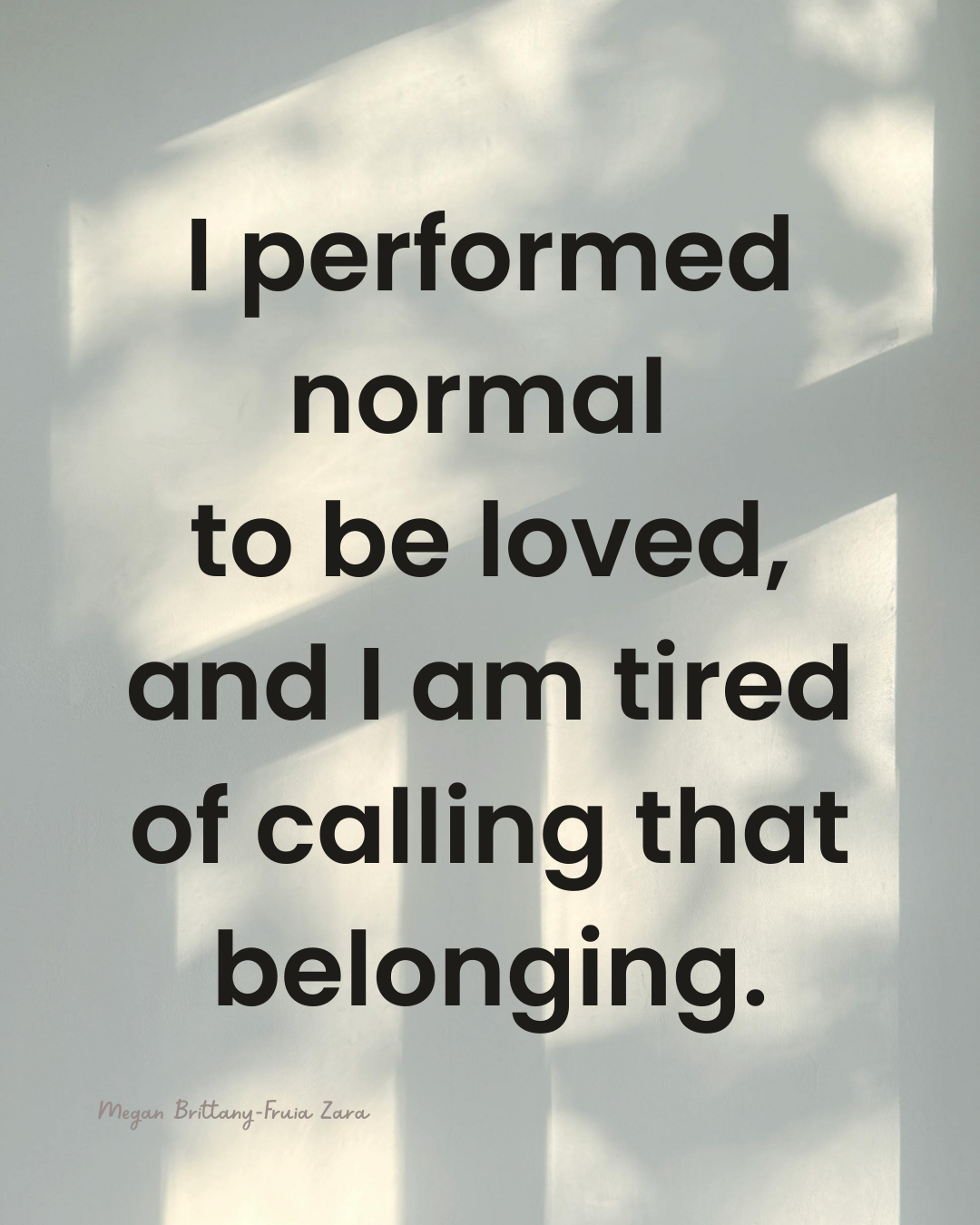
I performed normal to be loved, and I am tired of calling that belonging.
I think that is one of the most painful things about family, actually. We are told it should be the place where authenticity is safest, the place where you can be yourself, the place where love is not conditional. But I am not sure that is true for many of us.
I think authenticity is often hardest with the people closest to us. Because closeness does not only create intimacy. It also creates roles, expectations, myths, silent contracts, versions of you that other people have come to depend on. And the moment you become more honest, more whole, more difficult to categorize, you threaten the arrangement. To be authentic inside a family system is often to risk the love attached to your performance.
That is what I want to stop. I do not want to keep auditioning for belonging. I do not want to keep translating myself into something more digestible. I do not want love that only stays as long as I remain useful, manageable, or familiar. I do not want to keep mistaking emotional labor for intimacy. I do not want to keep confusing my ability to hold everyone together with evidence that I am being held too.
What I Think Family Might Be
I still do not have a neat answer. But I know it cannot only be blood. Blood is too accidental. It cannot only be history. History contains harm as often as tenderness. It cannot only be proximity. Plenty of people stay near us without ever really coming close. It cannot only be names, or roles, or obligation, or who is invited to the holiday table.
Maybe family is not who can claim you. Maybe it is who can receive you.
Maybe family is not who can claim you, but who can receive you.
Maybe family is where your full self does not trigger abandonment. Maybe family is where your humanity is not treated like an inconvenience. Maybe family is who notices your absence without needing to be told. Maybe family is who understands that love has to become effort in order to become real. Maybe family is the people who can make room for complexity without making someone disappear.
Maybe family is not a fixed category. Maybe it is a practice. A practice of showing up. A practice of staying. A practice of repair. A practice of making room for truth, even when truth unsettles the old arrangement.
I think I have known pieces of family. Echoes of it. Borrowed rooms. Temporary shelters. Love that was real but not sturdy. Belonging that was offered but not always protected. Enough to recognize the feeling. Not enough to trust it fully.
And maybe that is part of the grief too. Not that I have never known family, but that I have so often known it in fragments.
What I Want Now
I have spent a lot of my life trying to make meaning out of fragments. Trying to be enough that people would come toward me. Trying to prove I was worth the drive. Trying to earn steadiness through effort. Trying to become so good at loving that maybe I would finally feel fully chosen.
But you cannot force mutuality. You cannot labor your way into unconditional love. And you cannot perform yourself into safety forever.
What I want now is actually very simple, even if it has taken me a lifetime to say it.
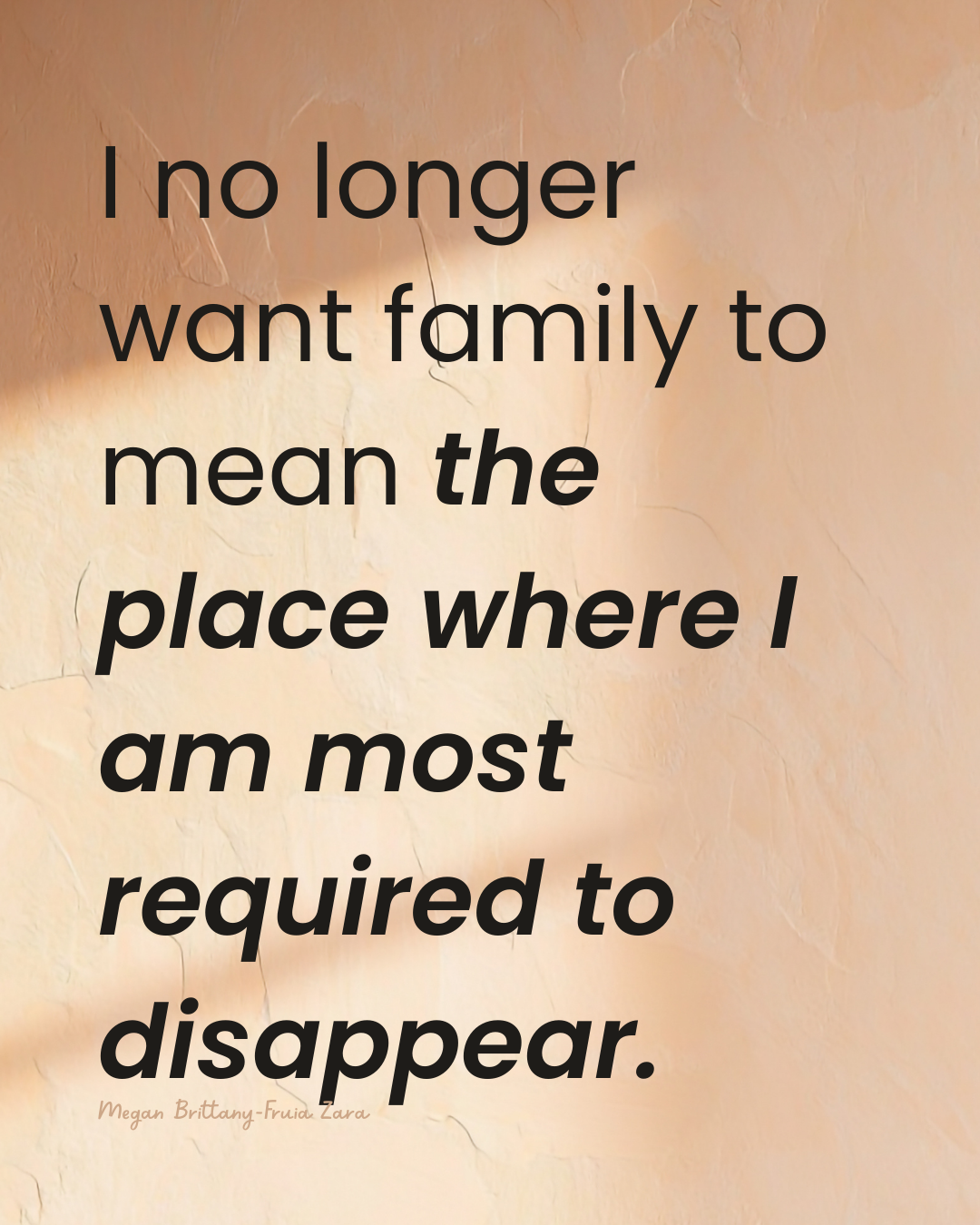
I no longer want family to mean the place where I am most required to disappear.
I want something truer than that. Something mutual. Something that does not collapse when I stop performing. Something that can survive honesty. Something that can hold complexity. Something that does not ask me to become less real in order to remain loved.
Maybe that is what I believe now, if I believe anything at all. It is possible to love people and still grieve them. It is possible to belong to people and still feel abandoned by them. It is possible to be central to a family’s functioning and still peripheral to its deepest loyalties. It is possible to come from people, build with people, raise children among people, and still spend years wondering where home actually is.
I am still wondering.
But I think I know this much now: family, if it means anything worth having, cannot just be the place where you are expected to stay loyal to a version of yourself that no longer fits. It has to be a place where truth does not exile you.
That is the kind of family I want. The kind I want to build. The kind I want my son to know. Not perfect. Not polished. But real.
A place where nobody has to earn their right to be fully seen.