Open Education Season 2026: A Capstone Update
Fall 2025: A Semester of Building and Learning
This fall semester has been one of prototyping, piloting, and learning from both successes and stumbles. As I approach the end of my second calendar year as the OER Librarian at the University of Texas at Arlington (I started in October 2023), I'm reflecting on how the work we've done in the past few months is setting the foundation for what comes next: Open Education Season 2026, a six-month research-in-practice initiative that will serve as my capstone for the THECB OER Fellowship.
The Badge Program Pilot
In August, we soft-launched the Open Education Trailblazers Badge Program, a self-paced Canvas course designed to create multiple entry points for students, faculty, staff, and community members to engage with Open Education. We advertised it through newsletters and reached out to colleagues across campus who had provided feedback on the program design earlier in the summer.
To kick things off, we ran a Launch Week with a webinar each day covering different aspects of the program. I'll be honest: attendance was not what we'd hoped. But we have the recordings, we learned what resonated and what didn't, and we gained clarity about what the program needs to succeed. Sometimes the most valuable learning comes from the things that don't go as planned.
The badge program remains its own initiative—self-paced, with content openly accessible to anyone. Currently, UTA students, faculty, and staff can earn badges, and the ultimate goal is to make badge earning available to everyone. Upon completion, the course will be added to Canvas Commons so other organizations and institutions using Canvas can access and adapt it for their own communities. Through the pilot, I learned that most people need more scaffolding and community support than a self-paced course alone can provide. That insight shaped everything that came next.
The Mini-Grant Pilot
This fall, we also piloted the Open Education Research & Planning Mini-Grant, a program designed to invite faculty into Open Education not by asking them to immediately adopt or create resources, but by supporting them to explore and evaluate OER in their disciplines.
The structure: faculty attend three working sessions throughout the semester where we guide them through the research process, we talk about pedagogy and evaluation, and they work on their own exploration with built-in support. At the end, they write a landscape brief sharing what they found, what surprised them, and what their next steps are, whether that's adoption, adaptation, or a thoughtful explanation of why OER doesn't work for their context yet.
We ran the pilot with 9 participants across multiple disciplines. Some were already OER enthusiasts. Others were openly skeptical. That mix was exactly what we wanted, because skeptics who are willing to explore become the most credible advocates. When someone with legitimate concerns investigates and then shares their findings, that narrative carries more weight than any amount of librarian cheerleading.
The pilot cohort is currently writing their landscape briefs, which will be reviewed and published in early 2026. The experience of running those sessions, the questions they asked, the barriers they named, the moments when something clicked, taught me more about program design than any amount of planning in isolation could have.
Learning from Community
This fall also brought two significant professional development experiences that shaped my thinking.
In October, I attended the THECB OER Fellowship gathering in Austin, where I met with my fellow fellows (yes, that's the term they use). Hearing about their work at other Texas institutions, the challenges they're facing, the creative solutions they're trying, the ways they're adapting to different institutional cultures, reminded me that this work is deeply contextual. What works at a community college looks different from what works at a research university. What resonates at one Hispanic-Serving Institution might not translate directly to another. There's no one-size-fits-all approach to building Open Education communities.
In November, I traveled to Denver for OpenEd25, the annual Open Education conference. I presented on invitation-centered design and care ethics in Open Education programming, and I made connections with people doing similar work at institutions across the country. Those conversations, over coffee, in hallways, during sessions, gave me language for things I'd been feeling but hadn't been able to articulate yet. The open education community is generous with both critique and encouragement, and I left Denver feeling more connected to the broader movement.
Also this fall, I applied for and was accepted into the Rebus Luminary Fellowship for Education Leaders, a three-month transformative experience offered by the Rebus Foundation in partnership with the Leadership Learning Community. The fellowship creates a joyful, safe space for up to 15 postsecondary leaders across Canada and the US to slow down, connect with peers, and explore collective leadership. Over three months, we'll gather for three virtual Community of Practice sessions and a culminating in-person Summit in Vancouver. The fellowship is grounded in the belief that leadership doesn't have to be lonely or exhausting—it can be restorative, playful, and liberatory. I'm excited to bring what I learn through that fellowship back to Season 2026 and to continue building connections with practitioners doing innovative work in open education across institutions and contexts.
Presenting the Work: A Milestone
This week, I presented Open Education Season 2026 to our team devoted to student success at the library: the librarians, director, and graduate research assistants who will help bring this initiative to life. The presentation ran just over an hour, and the questions my colleagues asked helped me continue to shape the program, especially around and with those who have a hand in the work. They asked about discipline-specific barriers to OER adoption, about how we can improve course marking systems so students can actually find affordable courses, about team capacity and sustainability.
The presentation was a milestone because it marked the transition from me piloting ideas to us building infrastructure together. Our library is restructuring to better support our community, and this new team and focus will allow us to do even more Open Education work. I am excited about the strengths and ideas this team is and will continue to bring to this work. And that collaborative shift is essential, because this work cannot be sustainable if it depends on one person doing everything.
What Is This Capstone, Really?
When I began at UTA in October 2023, I came to this position knowing almost nothing about Open Education Resources. I was learning to be an academic librarian, learning OER, living open practices and ideas without yet having the words for them. I didn't realize I was building toward something bigger until I started working on this capstone. The THECB OER Fellowship gives me the structure, support, mentorship, community of practice, and state backing to name what I had been building and put it into real action. Everything I learned from October 2023 through fall 2025, the relationship building, the research, the early pilots, was preparation for this fellowship capstone. What I've come to understand is that the capstone, and really all of my work, is a whole integrated system, and my task is to document whether care-based, invitation-centered design can shift institutional culture around Open Education.
The capstone has three interconnected deliverables:
1. The Canvas Course: Open Education Trailblazers Badge Program
An 18-badge, self-paced course organized across six pathways (Foundation, Bridge, Practice, Creation, Engagement, Advocacy) that creates multiple entry points for engagement at whatever level fits people's capacity and interests. The fall pilot taught us what this program needs to succeed, and we're redesigning it based on that learning.
2. The Pressbooks Book: "Open, On Purpose" working title
An openly licensed companion book that translates the research and theory into accessible language, using personal narrative to explore how Open Education connects to social justice, care ethics, and educational equity. This book is for everyone—students, faculty, staff, administrators, librarians, and community members—designed with multiple entry points and multiple stakeholders in mind. It's a book about Open Education that practices what it teaches: creating pathways for different kinds of participation and recognizing that everyone has a role to play in building more accessible, equitable learning environments.
3. The Academic Paper: "Widening the Circle" working title
A practitioner case study examining how narrative, community, and invitation can expand who participates in Open Education, grounded in critical pedagogy (Freire, hooks), communities of practice (Wenger), and care ethics (Noddings, Tronto). This paper will document the Season 2026 initiative and contribute to scholarship on open education program design.
But here's what matters more than the deliverables: this is practitioner autoethnography. My lived experience as a first-generation college graduate who struggled with textbook costs isn't bias to control; it's a lens that reveals patterns external researchers might miss. My positionality as a newly diagnosed autistic person who excels at asynchronous, digital-first communication shapes how I design for accessibility and multiple pathways. This isn't weakness; it's methodological strength.
The Theoretical Foundation: Why This Design?
The design of Season 2026 isn't arbitrary—it's grounded in three interconnected theoretical frameworks that have shaped my thinking about how communities form, how learning happens, and what care looks like in practice.
Critical Pedagogy: Education as Liberation
Paulo Freire argues that education can either domesticate or liberate, and that authentic education positions people as co-creators of knowledge rather than passive recipients (Freire, 2000). This insight shapes how I approach Open Education: not as a top-down mandate to “use free textbooks,” but as an invitation to examine whose knowledge is valued, who benefits from current systems, and how we might design more just alternatives.
I understand, in a very lived way, how access determines participation. As a first-generation college student, I depended on financial aid and loans to survive. Not having my textbooks on the first day was not a minor inconvenience; it was a barrier that immediately affected my capacity to learn. Buying older editions to save money often meant being out of sync with the course and at a disadvantage. Later, as an adjunct faculty member experiencing financial precarity myself, I saw the same pattern from the other side of the classroom: textbook costs do not simply add stress, they shape who can fully participate in their own education. That is why I treat affordability as a structural equity issue, not a customer-service problem.
bell hooks extends Freire’s work by explicitly centering care, vulnerability, and embodiment in pedagogy. In Teaching to Transgress, she frames education as the practice of freedom and insists that the classroom can be a site where students and teachers show up as fully human (hooks, 1994). That framing matters for Open Education work because we cannot ask for vulnerability, experimentation, and reflection from faculty and students while presenting ourselves as polished, finished, and unaffected. If we want a learning culture, we have to model learning. If we want a humane culture, we have to model humanity.
I learned what it looks like to treat people as co-creators of knowledge in the summer of 2015, when I was part of the faculty and staff who opened Trent Middle School in Frisco, Texas. We built the school’s mission and values through a collaborative retreat: writing in pairs, merging and revising in larger and larger groups, and iterating until the final statement belonged to everyone. The mission that emerged, still in use today, reflects that collective authorship: “At Trent Middle School, we are a family, we embrace our differences, and we take ownership of our education and actions.” That experience shaped my design instincts. When people have meaningful voice, shared ownership becomes real. When people are treated as implementers, buy-in becomes performative.
This is why the mini-grant program is structured as a set of supported working sessions rather than a one-way distribution of resources. It is also why I share my learning process openly through LinkedIn, OER newsletters, and now this blog. Transparency is not a branding strategy for me; it is a pedagogy and a trust practice. In leadership research, Kouzes and Posner describe “modeling the way” as aligning actions with stated values and making commitments visible through consistent follow-through (Kouzes & Posner, 2023). If I am asking the community to take risks, share their learning publicly, and build something new, I need to show my work first.
Communities of Practice: Learning as Belonging
Etienne Wenger’s communities of practice framework argues that learning is fundamentally social and develops through participation in shared practices over time (Wenger, 1998). He describes communities of practice as characterized by mutual engagement, joint enterprise, and shared repertoire. These are not outcomes you can mandate; they emerge when people have repeated opportunities to participate, contribute, and build meaning together.
This is why Season 2026 is designed around multiple entry points and ongoing engagement rather than one-time workshops. One-time workshops can be useful for awareness, but they rarely create the conditions for mutual engagement to take root. In the mini-grant program, we are not simply giving faculty resources and sending them away. We intentionally build in discussion, thinking, and working time so shared practice can form. We also learned from our fall pilot that 60 minutes was not enough time for meaningful exploration and collaborative problem-solving, so we are expanding sessions to 90 minutes and adding an additional session for a total of three workshops, with one being in-person (with lunch) to support relationship-building.
During the fall mini-grant sessions, I watched mutual engagement emerge organically. Faculty shared resources with one another, built on each other’s ideas, and troubleshot discipline-specific concerns together. They compared what they were finding in OER searches and helped each other interpret licensing and platform options. What changed was not just knowledge, but confidence and connection. The shared practice of exploring Open Education together created trust that no one-way presentation could replicate.
While I am deeply tech-forward and believe that anything that can be remote should be remote for access and flexibility, I also recognize that belonging is not experienced the same way by everyone. Designing a hybrid structure, including a purposeful in-person session, is one way of acknowledging varied needs and interaction preferences without treating any one modality as the default “right” way to participate. The goal is not attendance; the goal is a learning community.
The mini-grant cohorts create faculty learning communities where OER exploration is shared practice. The badge program creates pathways for multiple kinds of participation, including inviting students to be knowledge-producers rather than only beneficiaries. These are all attempts to design for the conditions of community, rather than hoping adoption happens through information alone.
Care Ethics: Making Care Visible and Collective
Joan Tronto defines care as the work we do to “maintain, continue, and repair our world so that we can live in it as well as possible,” and she emphasizes care as a democratic responsibility, not a private virtue (Tronto, 2013). She describes care as involving attentiveness (noticing need), responsibility (taking it on), competence (doing it well), and responsiveness (listening to how care is received). Nel Noddings similarly emphasizes care as relational and grounded in the perspective of the cared-for when defining what counts as caring (Noddings, 1984).
Care ethics becomes clearest for me when I can point to a moment where care was not only intended, but recognized by the person receiving it. In my Teaching Literacy Across the Curriculum course, most of my roster was made up of pre-service teachers in electives and fine arts: band, orchestra, choir, dance, theatre. Early on, they named a structural reality I did not fully understand until I listened closely: three-hour “lab” courses often count as just one credit hour, which can make their schedules unusually dense and exhausting. That constraint shaped their capacity, their stress, and their relationship to coursework. So I chose to teach the course according to the needs, fears, and goals of the students actually in front of me, rather than rigidly following the original course design. In Tronto’s terms, this was attentiveness to need, responsibility for addressing it, competence in adjusting the learning environment, and responsiveness to how care landed (Tronto, 2013). I saw the results in the work they produced, the engagement they sustained, and in feedback like the note in Figure 1, where a student explicitly names flexibility and understanding as part of what made learning possible, and connects that experience to the kind of teacher they hope to become.
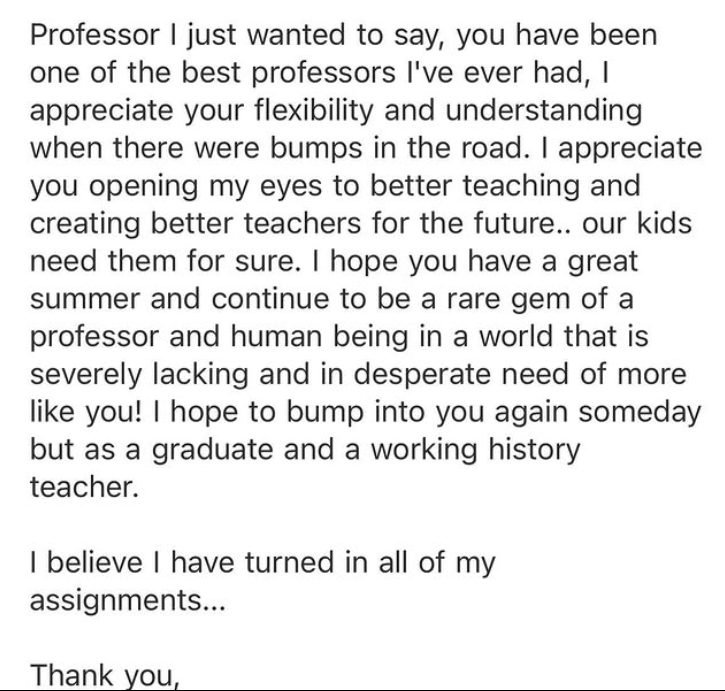
Figure 1. End-of-term message from a student in Teaching Literacy Across the Curriculum, a course for pre-service teachers outside literacy/reading specialization (including band, orchestra, choir, dance, theatre, and other electives).
These frameworks challenge me to ask: what does it mean to care for the Open Education community at our institution? It means noticing who is missing and why. It means creating structures that respect people’s capacity and constraints. It means building in feedback loops and being willing to change course. It also means treating textbook costs as a justice issue that requires collective response, not as an optional affordability perk.
Care ethics becomes even more concrete for me when I think about disability and workplace accommodation. I live with chronic mood disorders that significantly affect how I function in standard work expectations. I was also diagnosed with autism in October of this year, and I am entitled to reasonable accommodations that support me in doing my work effectively. Under the ADA, employers have obligations around reasonable accommodation, and the legal concept of "undue hardship" is defined in terms of "significant difficulty or expense" (42 U.S.C. § 12111(10); 29 C.F.R. § 1630.2(p); U.S. Equal Employment Opportunity Commission, 2002). Even when a process is legally compliant, it can still feel, from the employee side, less like care and more like risk management. That tension is part of what I am naming here.
This is one example of how systems meant to "care for people" often are not actually designed that way, even when that is what they claim to do. In my case, one of my accommodations includes additional remote time built into my work week, and my remote days should be static so I can plan around them for both workload and regulation. Predictability and routine are commonly discussed needs for autistic people, and disruptions can increase distress and anxiety (National Autistic Society, n.d.). In workplace accommodation contexts, resources like the Job Accommodation Network list options such as modified schedules and telework among accommodation possibilities for employees with autism (Job Accommodation Network, 2013), and they emphasize an interactive process where the employee and employer work together to determine effective accommodations (Job Accommodation Network, n.d.). But when mandatory in-person events can be scheduled on days that were planned as remote days, the accommodation lacks the predictability I need. It can be overridden when deemed an "undue hardship," which reframes what should be basic care for humans as something exceptional that can be conditional. When accommodations are treated as exceptions rather than as foundational elements of humane work design, they become unreliable, and care becomes compliance rather than commitment.
This experience shapes how I design Season 2026. When I ask faculty to estimate time commitments for the mini-grant, when I offer multiple pathways into the Trailblazers program, and when I build a three-tiered team structure that allows colleagues to choose their level of involvement, I am operationalizing care as structure. I am also trying to notice who is missing from Open Education conversations at UTA and why. Students are ultimate stakeholders, and if I take seriously the idea that everyone is (or can be) a student, then leaving students out is not a minor gap, it is a design flaw. I also see uneven adoption patterns across departments, which suggests that OER has often been framed as a tool rather than as a shift in practice and values. For leaders especially, care-informed change requires more than adoption counts; it requires qualitative evidence about long-term impact, workload realities, and return on investment.
Care ethics also helps me name a broader institutional tension: care work is often treated as invisible, voluntary, and feminized labor that sits outside what gets measured as “real” professional work (Tronto, 2013; Noddings, 1984). I have been doing care work for as long as I can remember. In K–12 teaching, that looked like building safe environments through vulnerability and fallibility, keeping snacks and extra supplies, and designing systems that redistributed expertise and dignity. When I taught sixth grade technology applications, I flipped my classroom so students could work through highly supportive, self-paced learning, and I created a peer “tech support system” with explicit norms about guiding rather than taking over. That system reduced bottlenecks, increased student agency, and made it possible for me to conference more deeply with students rather than spending all of class time troubleshooting. Students also evaluated my lessons in ways that created feedback loops and surfaced needs they might not otherwise name.
Here is the tension I keep returning to: the care that makes learning possible often does not “count” in institutional structures. Making care central to program design is practical because programs do not sustain without it. It is also political because it challenges what we value and what we measure.
Methodology: Practitioner Autoethnography
Methodologically, this project draws on practitioner autoethnography (Chang, 2008; Custer, 2014), a research approach that positions the practitioner's lived experience and systematic reflection as legitimate sources of knowledge. Rather than trying to eliminate my positionality, I'm using it as an analytic lens.
This approach is particularly appropriate for Open Education research because our field values transparency, reflexivity, and the democratization of knowledge production. If we believe students' lived experiences count as knowledge, then practitioners' experiences building programs should count too. The goal isn't to produce generalizable findings but to offer thick description, documented decision-making, and transparent reflection that others can learn from and adapt to their own contexts.
How These Frameworks Connect
These three frameworks, critical pedagogy, communities of practice, and care ethics, aren't separate. They reinforce each other:
Critical pedagogy asks: Who gets to participate, and how do we create conditions for liberation?
Communities of practice shows: Learning happens through belonging and mutual engagement.
Care ethics demands: We must attend to relationships, capacity, and systemic barriers.
Together, they suggest that Open Education programs should be invitation-centered (creating multiple pathways for participation), community-focused (building relationships and shared practices), and care-based (attending to capacity and honoring people's full humanity).
This is the foundation Season 2026 is built on.
The origin story of Season 2026 isn't one moment but one semester. Fall 2025, the initial pilot semester, was so rich with learning, networking, new opportunities, new thinking, and new understandings. Having the experience of fall 2025 was the pivotal moment. Planning the spring 2026 semester with everything we'd learned and researched allowed the theoretical frameworks to move from abstract ideas to lived practice.
What This Work Is Really About
What I'm learning from this work is that Open Education is not just about making resources free. It's about questioning who gets to learn, who gets to teach, who gets to decide what counts as knowledge, and how we build systems that honor everyone's humanity. The frameworks I'm using, critical pedagogy, communities of practice, and care ethics, point toward a different way of working: slower, more relational, more attentive to need and capacity. This work requires vulnerability, patience, and a willingness to be wrong. It also requires documentation, reflection, and a commitment to sharing not just the wins, but the stumbles and the questions that don't yet have answers.
I'll continue documenting what we're learning throughout Season 2026. If you're interested in following along, you can find updates here, on my blog, and through my social media channels.
I'd love to hear from others doing similar work at your institutions: What resonates? What feels unrealistic? What am I missing?
Let's learn together.
Sincerely,
Megan
References
29 C.F.R. § 1630.2(p) (2026). https://www.ecfr.gov/current/title-29/subtitle-B/chapter-XIV/part-1630/section-1630.2
42 U.S.C. § 12111(10) (2026). https://www.govinfo.gov/link/uscode/42/12111
Boulter, C., Freeston, M., South, M., & Rodgers, J. (2014). Intolerance of uncertainty as a framework for understanding anxiety in children and adolescents with autism spectrum disorders. Journal of Autism and Developmental Disorders, 44, 1391–1402. https://doi.org/10.1007/s10803-013-2001-x
Chang, H. (2008). Autoethnography as method. Left Coast Press.
Custer, D. (2014). Autoethnography as a transformative research method. The Qualitative Report, 19(37), 1–13. https://doi.org/10.46743/2160-3715/2014.1011
Freire, P. (2000). Pedagogy of the oppressed (30th anniversary ed.; M. B. Ramos, Trans.). Continuum. (Original work published 1970)
hooks, b. (1994). Teaching to transgress: Education as the practice of freedom. Routledge.
Jenkinson, R., Milne, E., & Thompson, A. (2020). The relationship between intolerance of uncertainty and anxiety in autism: A systematic literature review and meta-analysis. Autism, 24(8), 1933–1944. https://doi.org/10.1177/1362361320932437
Job Accommodation Network. (2013, June 7). Employees with autism spectrum disorder (Accommodation and Compliance Series). https://www.corada.com/documents/employees-with-autism-spectrum-disorder/accommodations
Job Accommodation Network. (n.d.). Accommodation process. https://askjan.org/topics/AccommodationProcess.cfm
Kouzes, J. M., & Posner, B. Z. (2023). The leadership challenge: How to make extraordinary things happen in organizations (7th ed.). Wiley.
National Autistic Society. (n.d.). Preference for order, predictability or routine. Retrieved January 26, 2026, from https://www.autism.org.uk/advice-and-guidance/topics/about-autism/preference-for-order-predictability-or-routine
Noddings, N. (1984). Caring: A feminine approach to ethics and moral education. University of California Press.
Normansell-Mossa, K. M., Top, D. N., Russell, N., Freeston, M., Rodgers, J., & South, M. (2021). Sensory sensitivity and intolerance of uncertainty influence anxiety in autistic adults. Frontiers in Psychology, 12, Article 731753. https://doi.org/10.3389/fpsyg.2021.731753
Tronto, J. C. (2013). Caring democracy: Markets, equality, and justice. New York University Press.
U.S. Equal Employment Opportunity Commission. (2002, October 17). Enforcement guidance on reasonable accommodation and undue hardship under the Americans with Disabilities Act. https://www.eeoc.gov/laws/guidance/enforcement-guidance-reasonable-accommodation-and-undue-hardship-under-ada
Wenger, E. (1998). Communities of practice: Learning, meaning, and identity. Cambridge University Press.