Beyond Adoption: Teaching the Open Education Landscape

A Room That Felt Different
The first thing I noticed wasn’t the agenda. It was the absence of a certain kind of performance. No one was auditioning for the “perfect Open Education story.” No one was smoothing the hard parts into something palatable. The room felt softer and sturdier at the same time.
When I walked into the The University of Texas (UT) System Momentum on OER Convening, I expected the usual higher ed signals: name tags, polite applause, the low-grade pressure to sound certain. Instead, I felt something else. A room shaped by Open Education values, not just Open Education vocabulary. Caring. Vulnerability. Grace. The quiet sense that no one was here to ‘win’.
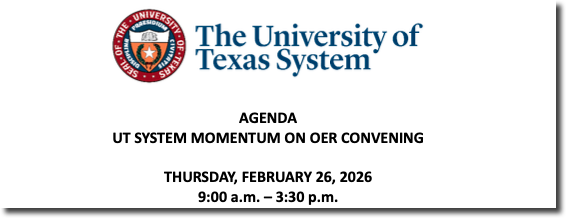
That can be surprising in higher education; we aren’t always good at sitting with uncertainty. We like conclusions. We like clean outputs. We like the story where we did a thing and it worked. But this day was full of people telling the truth about what is working, what is not, and what we are still learning across 13 of the University of Texas System’s campuses and sites.
It did not feel like a performance of success. It felt like people practicing shared responsibility in real time.
Care Ethics is Not a Vibe. It is an Operational Choice.
I keep coming back to the word care because it is easy to romanticize it in Open Education spaces. But care ethics, at least the way I think about it in higher education, is not a soft add-on. It is a design stance: a commitment to building structures that reduce avoidable harm.
In practice, that means we stop treating “time-poor” faculty and “overextended” students as unfortunate background conditions. We treat them as the conditions we are designing for. We ask: what does a reasonable pathway look like for a person teaching four courses, supervising students, doing service, and still trying to do right by learners who cannot afford more barriers?
That is why the convening mattered to me. The room felt caring not because people were polite, but because the day was organized around honesty and mutual reality. The grace was structural.
Systems Design: The Work Underneath the Work
One of the most consistent mistakes I see in Open Education initiatives is that we treat adoption like an individual moral choice rather than a systems problem. If the process requires specialist knowledge, hidden labor, and invisible decision-making, we should not be surprised when it stays niche.
Systems design is simply the practice of noticing where the friction is and building something that makes the right next step easier. Not for the “ideal” faculty member. For real humans. That is why I am drawn to artifacts, workflows, and scaffolds. They are not bureaucracy. They are equity infrastructure.
The Bottleneck: Where OER Grants Break Down in Practice
I was invited as a lightning talk presenter to share a prototype I built for our campus: an Open Education mini-grant model that does something deceptively simple. It funds rigorous exploration, not premature adoption. It pays people to learn the landscape, document what they find, and leave behind something the next educator can actually use.
Here is the tension that brought me to that mic. Traditional OER grants often assume people already know the Open Education landscape. They assume repository literacy. They assume licensing fluency. They assume time. And when those assumptions are wrong, faculty do one of two reasonable things: they opt out because the risk feels irresponsible, or they adopt too early and the implementation collapses quietly later. Neither outcome is a character flaw. It is a design problem.
What I Shared: An On-Ramp into Open Education
My lightning talk was titled, “Open Education Research & Planning Mini-Grant: An On-Ramp into Open Education.” The phrase ‘on-ramp’ matters to me. It names the part we keep skipping: the moment before adoption, when a person needs structure, not cheerleading; method, not a mandate; permission to say, “I do not know yet,” and a way to find out.
Introducing: Rigorous OER Exploration
When I say “rigorous OER exploration,” I am not talking about a scavenger hunt. I am not talking about a frantic night of Googling and a folder of tabs you never return to. I mean a repeatable, reviewable research practice for course resource decisions. A defined question. A scoped search strategy. Transparent criteria. Documentation of what you ruled out and why. A clear decision point: adopt, adapt, create, or not yet.
The goal is not to force a specific outcome. The goal is to make the outcome defensible.
Because Open Education is not only about cost. It is about trust. It is about being able to look a student in the eye, or read their email at 11:47 p.m., and know that we made choices we can stand behind.
The Tool That Makes the Work Visible: The OER Tracker
The tool that tends to land hardest when I explain this model is also the one that looks the least glamorous on paper: the OER Tracker. I call it “the method in a page.” The Tracker is not a deliverable for show. It is an instrument that captures the actual search trail: where we looked, what we found, what we ruled out, and why.
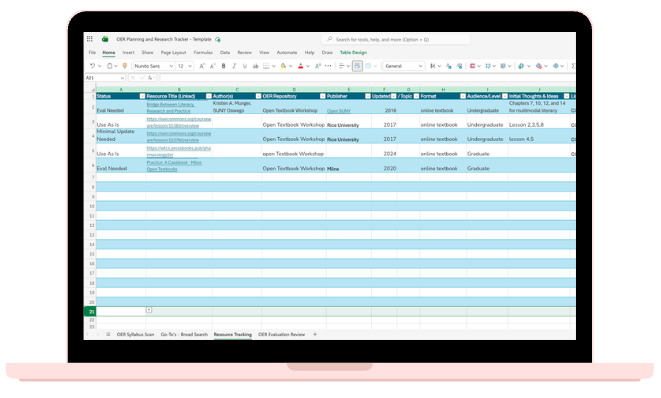
It prompts for licensing clarity (or lack of it), accessibility and format signals, fit for course outcomes and learners, update status and credibility signals, and the specific reason something did not make the cut.
That accessibility piece is not optional for me. If we are doing Open Education in a way that assumes students can read anything, on any device, with any bandwidth, with no disability-related barriers, we are reproducing the same inequities with a different price tag. Open does not automatically mean accessible. But accessible has to be part of what “good” means.
Why does that matter? Because “I searched” is not evidence. A visible trail is. The Tracker protects educators from being asked to make high-stakes, student-facing decisions in the dark. It also creates something higher education desperately needs but rarely budgets for: institutional memory. When faculty turnover happens, when roles shift, when a new librarian inherits a program, the work does not evaporate. The next person is not starting from zero.
When the Rigorous Answer is “Not Yet”
Sometimes the rigorous answer is “not yet.” Not yet, we do not have an open resource that is current enough. Not yet, we do not have something that meets the accessibility threshold our learners deserve. Not yet, we do not have a text that matches the scope and depth of a specialized course.
That is not failure. That is risk reduction. That is student protection. That is a documented gap your institution can actually do something about.
Rigorous exploration turns “I wish there was…” into “Here is what exists, here is what is missing, and here is what it would take to make adoption feasible.” Not as a hot take. As evidence.
What Participants Produced (and why it matters)
In the Fall 2025 pilot cohort, participants did not just “learn about OER.” They produced Landscape Briefs: discipline-specific, evidence-based documents that map what exists, what is missing, and what adoption would realistically require.
-
This project explores whether SOCW 5313 can move away from an aging, moderately expensive textbook toward a curated no-cost model built from existing OER plus freely accessible articles where gaps remain. The team reviewed 11 OER sites, identified four promising OER books related to program evaluation, and mapped those resources against the course’s 14 textbook chapters.
“We previously thought it would be overwhelming to develop OER for this class and believed it required us to write a new OER textbook from scratch. We learned that we can start by looking for existing OER, rather than starting from scratch.”
Attribution: unpublished landscape brief (Fall 2025 pilot cohort; submitted Feb. 2, 2026).
-
This project focuses on redesigning NUR 5434 to improve equity, engagement, and affordability by replacing most commercial textbooks and paid platforms with open and no-cost clinical resources. Rather than relying on a single textbook substitute, the project proposes a modular approach that combines OER, open-access clinical guidelines, multimedia tools, and faculty-developed materials.
“Open education does not require reliance on a single static resource; rather, it allows for intentional curation of current, open-access clinical guidelines, government-supported resources, professional organization materials, and peer-reviewed literature.”
Attribution: unpublished landscape brief (Fall 2025 pilot cohort; submitted Jan. 14, 2026).
-
This project examines the OER landscape for UTA’s Spanish as a Heritage Language program as part of a larger effort to strengthen and redesign courses serving bilingual and heritage Spanish learners. After reviewing major OER repositories and following leads through a snowball discovery process, the author identified a strong pool of relevant texts but concluded that no single resource fully meets the program’s needs.
“While I found many useful materials in the OER textbooks listed above, none of them alone would meet the needs of our SHL program. I would adapt and remix materials from the above texts and would create new materials to supplement the areas that are lacking.”
Attribution: unpublished landscape brief (Fall 2025 pilot cohort; Feb. 16, 2026; project materials in progress).
Taken together, these Landscape Briefs matter because they turn OER interest into institutional memory: decision-ready evidence about what exists, what’s missing, and what it would actually take to adopt, adapt, or build with integrity.
Making the Method Transferable: OE Mini-Lessons Now Openly Available
If the only people who can participate in Open Education are the ones with spare time, prior knowledge, and high tolerance for ambiguity, then the system is selecting for privilege. A mini-lesson sequence is not just a convenience feature. It is an access strategy for busy, brilliant educators who need a path that is clear enough to walk.
So I am making the core learning sequence openly available: The Open Education Mini-Lesson Series. Access point: Open Education (OE) Mini Lessons: UTA OE Trailblazers
A Course-Catalog Overview of the 7 Mini-Lessons
-
Discovering What’s Already Out There
Start the search with less overwhelm: where to look, how to dig, what to notice, and how to begin building your own “go-to” list of repositories and collections.
-
How to Search and Track OER (Without Losing Your Mind)
Set up the OER Search & Tracking Workbook and use it to run early keyword searches across repositories, capture first impressions, and log resources (including license status, even when it’s unknown).
*This is the lesson where you anyone can get a Google Sheets copy of the OER Tracker.
-
Make a Fit Decision You Can Stand Behind
Move from “I found something” to “I can justify this choice.” Define what fit means for your learners, evaluate a resource, and document strengths, risks, and your verdict.
-
Because the Textbook Is Rarely the Whole Story
Explore ancillaries (slides, test banks, assignments, labs) and capture practical customization ideas as you move from discovery into real selection.
-
What Can I Do With What I Find?
Understand the 5Rs, interpret Creative Commons licenses, check compatibility, and write clean attribution so you can revise, remix, and share with confidence.
-
Where Can I Build & Host OER?
Compare platform options using real criteria (access, discoverability, remixability, long-term access) and draft a simple hosting plan.
-
OER as a Collaborative Process
Explore collaboration and open pedagogy as sustainability strategies: distributing workload, widening expertise, and inviting students into knowledge-making in realistic, bounded ways.
A Lightning Talk Moment I Keep Thinking About
In the Q&A after my lightning talk the Associate Vice Chancellor for Academic Affairs, asked a question I hear in different forms all the time: should the Tracker be used only for OER, or can it be used to evaluate everything a faculty member is considering, including commercial resources?
My answer was yes. Use it for everything.
The Tracker is agnostic by design. Faculty can track any resources they want to consider while building, revising, or overhauling curriculum. Two columns make this work especially well. The first is the License column, a dropdown that includes open licenses but also copyrighted and unknown. The second is the What you can do with it column: based on the license selection, it populates with what that license means and how the resource can be used.
That is the point of rigorous exploration. Not to force a pure outcome. To give people a structured way to compare options and make decisions they can defend.
Who This Helps & How
Open Education advocates, faculty, and librarians often share values, but we do not always share context. One reason I care about the mini-lesson format is that it makes the method legible across roles.
-
Why: you need a pathway that respects your time and protects your students.
Takeaway: rigorous exploration is a way to make adoption (or “not yet”) defensible, not a way to add busywork.
-
Why: you are often asked to scale support without scaling your hours.
Takeaway: the Tracker and the mini-lessons externalize expertise into a repeatable method, so support is not trapped in one person’s head.text goes here
-
Why: materials decisions are also course design decisions.
Takeaway: evaluation criteria (especially accessibility and fit) become shared language that strengthens design conversations.
-
Why: you need credible, assessment-ready evidence without turning everything into a compliance exercise.
Takeaway: this model produces documentation you can point to, even when adoption is not immediate.
-
Why: affordability decisions are learning decisions.
Takeaway: rigorous exploration is one way institutions reduce financial and access barriers without sacrificing quality.
What I Want to Keep From That Day
I left that day feeling two things at once. Relief, because I was in a room where people were telling the truth. And responsibility, because the truth is we do not need more slogans. We need more scaffolding. Not as extra. As the intervention.
We do not scale Open Education by asking one passionate person to carry it alone. We scale it by building methods, tools, and shared language that make good decisions easier to make, and make the work visible enough that others can pick it up. Traditional OER grants assume the Open Education landscape is already known. This mini-grant teaches it. And that is how adoption becomes durable.
And maybe that is what I am still holding from that room in Austin: the sense that Open Education does not have to be a performance.
Not as perfection.
Not as a tidy success story.
But as a practice.
A practice of care made operational. A practice of systems built for real conditions. A practice of shared responsibility, repeated until it becomes infrastructure.