McGraw Hill’s “Buyer’s Guide” to OER Is a Marketing Brochure Wearing Academic Glasses
McGraw Hill recently published a PDF called Open Educational Resources (OER) vs. McGraw Hill (MH) Affordable Access Model: Buyer’s Guide. (McGraw Hill, n.d.)
I read it the way I read anything that wants to make decisions for faculty and students: through the values of open education and what I’m learning about care ethics, a lens that asks who is being cared for, who is being managed, and who is carrying the hidden costs.
Here’s the part most people miss: documents like this are not just informational. They are instructional. They teach you what to measure, what to fear, and what to treat as “inevitable.”
So consider this your backstage pass. I’m going to walk through what the guide says, what it quietly assumes, and what it leaves out, with citations.
Because it’s not really a buyer’s guide. It’s a framing device. And framing is power. (McGraw Hill, n.d.)
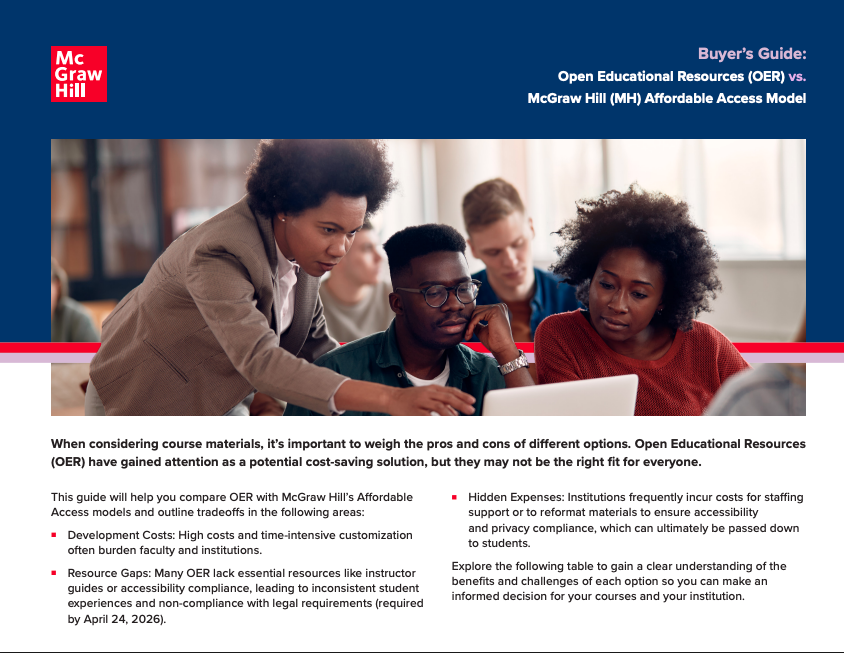
Figure 1. Cover page from Open educational resources (OER) vs. McGraw Hill (MH) affordable access model: Buyer’s guide (McGraw Hill, n.d.). https://www.mheducation.com/content/dam/mhe/highered/documents/affordable-access/buyers-guide-affordable-access-model-vs-open-educational-resources.pdf
1) The guide compares a bicycle to a dealership
The sleight of hand here is structural. McGraw Hill isn’t really comparing learning materials. It’s comparing an ecosystem to an object.
On one side: OER, framed as a pile of files.
On the other: McGraw Hill Affordable Access, framed as a full stack solution: platform, analytics, LMS integration, training, support, and reporting. (McGraw Hill, n.d.)
If you compare “content” to “content plus platform plus services,” the bundle will always look more “robust.” That isn’t scholarship. It’s packaging design.
And it matters, because the honest question was never “OER vs McGraw Hill.” The honest questions are more inconvenient and more useful:
What content best serves the learning outcomes in this course?
What environment supports the pedagogy I actually use?
What support do faculty and students need to succeed, and who provides it?
What do students give up, or gain, around privacy, access, and long-term ownership?
The guide compresses all of that complexity into one binary and labels the result neutral. It isn’t. (McGraw Hill, n.d
2) “OER isn’t really free” is a category error dressed up as math
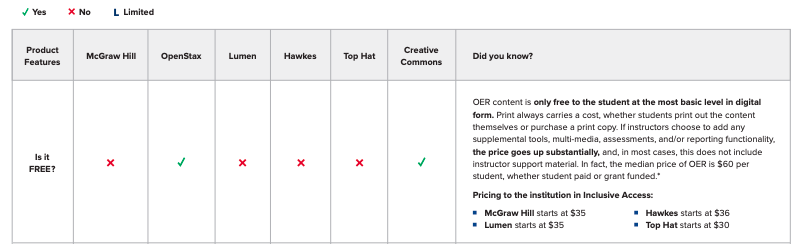
Figure 2. Table excerpt describing OER as “only free… at the most basic level” (McGraw Hill, n.d.). https://www.mheducation.com/content/dam/mhe/highered/documents/affordable-access/buyers-guide-affordable-access-model-vs-open-educational-resources.pdf
The guide suggests OER is only free “at the most basic level,” then folds printing costs and optional paid tools into the definition of OER itself, ultimately constructing a “median price” narrative. (McGraw Hill, n.d.)
But OER is not defined by “cheap PDFs.” OER is defined by permissions: the legal right to retain, reuse, revise, remix, and redistribute. Those permissions are the whole point because they shift control back to educators and learners. (BCcampus, n.d.; UCF OER Starter Guide, n.d.)
This is also where the guide’s framing quietly collapses the most important question: who benefits from the return on investment?
In a publisher platform model, the “ROI” is structured around recurring payments, product ecosystem lock-in, and scale. Those savings are often marketed as being “for students,” but the system is optimized for vendor continuity. In an OER model, ROI is distributed and durable: students retain access, faculty can improve materials over time, and institutions build teaching infrastructure that persists across semesters instead of expiring when the contract does. (BCcampus, n.d.; Tlili et al., 2023)
More importantly, OER is not merely “replacing” commercial textbooks. It supports academic freedom as lived practice: disciplinary experts decide what belongs in the learning environment and can revise resources to reflect their students, their community, emerging scholarship, and cultural relevance in ways commercial publishing is structurally slower to do. (AAUP, 1940/1970; BCcampus, n.d.)
That autonomy is what makes open pedagogy possible: assignments where students contribute knowledge, share work publicly when appropriate, and see themselves represented not only as consumers of content but as participants in its creation. A boxed, time-limited product cannot offer that as a feature because it conflicts with the underlying business model. (BCcampus, n.d.)
So when optional commercial add-ons are treated as inherent “hidden costs” of OER, the guide isn’t describing OER. It’s describing a preferred end state: every adoption flows toward a platform.
That’s not analysis. That’s incentives. (McGraw Hill, n.d.)
3) The guide uses accessibility urgency to imply vendor dependency
McGraw Hill flags legal accessibility requirements and frames OER adoption as a compliance risk. (McGraw Hill, n.d.)
Let’s name what is true: accessibility deadlines are real, and the stakes are high. The U.S. Department of Justice’s ADA Title II rule sets compliance dates of April 24, 2026 for larger public entities and April 26, 2027 for smaller ones and special district governments. (U.S. Department of Justice, 2024)
Now let’s name what’s happening rhetorically: the guide uses that urgency to quietly smuggle in a conclusion it never has to defend on the merits. The implied logic is simple: the deadline is scary, OER is risky, therefore the safe choice is the vendor platform.
But compliance pressure does not equal vendor dependency. And a vendor product is not a guarantee of accessibility.
Accessibility is not a logo you buy. It is a practice you build: authoring formats that work (HTML/EPUB/tagged PDFs), clear workflows, procurement standards, ongoing testing, remediation plans, and institutional accountability. Vendor tools can be part of that ecosystem, but they do not replace it. (U.S. Department of Justice, 2024)
And here’s what the guide conveniently ignores: accessibility is deeply embedded in the open movement, not as a checkbox, but as an ethic. The people who build, adapt, and steward OER tend to be doing accessibility because they are trying to take care of humans, not because a contract requires it. That orientation matters. It changes how quickly issues are fixed, how openly improvements are shared, and whether accessibility becomes a living feature of the resource instead of a compliance statement filed away in procurement. (BCcampus, n.d.; U.S. Department of Justice, 2024)
If we want to talk about accessibility ethically, the questions are concrete:
What documentation exists (VPAT/ACR), and what is the scope?
What known exceptions remain?
What is the remediation timeline?
And what happens when a student needs an accessible version next week, not next quarter?
Those questions apply to OER, to publisher platforms, and to every tool in the learning ecosystem. The difference is whether we treat accessibility as a compliance event or a care practice. (U.S. Department of Justice, 2024)
4) “Open source” security talk is a scarecrow argument
The guide blurs OER into “open source,” then gestures ominously at malware, phishing, and platform vulnerabilities. (McGraw Hill, n.d.)
This is less an argument than an atmosphere. If you can make “open” feel dangerous, you do not have to engage what open actually means.
But words matter here. OER is openly licensed educational content. “Open source” is a software licensing framework. They are adjacent in values, not interchangeable in definition. Conflating them is not precision; it’s a rhetorical fog machine. (BCcampus, n.d.)
And the threat model is misfired. Yes, any file from anywhere can be malicious. That is why institutions have IT security policies, safe download practices, and approved repositories. But “files on the internet can be unsafe” is not an OER-specific flaw. It is a general condition of being online. (McGraw Hill, n.d.)
5) The guide sells “student success” as “vendor analytics”
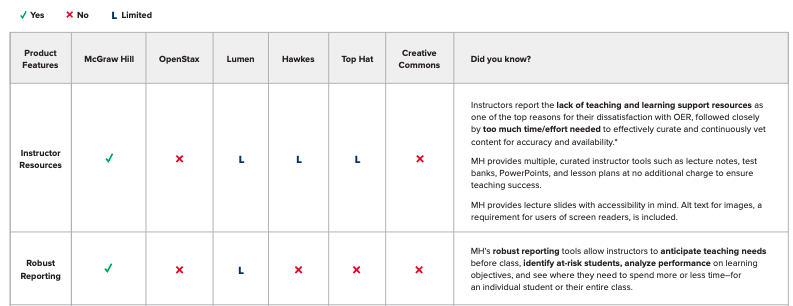
Figure 3. “Robust reporting” table excerpt referencing identification of “at-risk students” (McGraw Hill, n.d.). https://www.mheducation.com/content/dam/mhe/highered/documents/affordable-access/buyers-guide-affordable-access-model-vs-open-educational-resources.pdf
The guide leans hard on dashboards, reporting, and identifying “at-risk students.” (McGraw Hill, n.d.)
Analytics can be useful. They can also be power: surveillance power, governance power, and commercial power. When “student success” is reduced to what a platform can count, the platform quietly becomes the curriculum.
And those glossy engagement metrics often leave out the most important variable: consent. In many automatic-billing models, students may not fully understand they can opt out, and even when opt-out exists on paper, course design can make opting out academically punishing. If assignments, quizzes, or access to core materials are tied to the platform, “engagement” can become a requirement, not a choice. (InclusiveAccess.org, n.d.; Student PIRGs, 2024)
Student privacy concerns in digital learning tools are well documented, including gaps in transparency and limited protections. (Privacy Rights Clearinghouse, 2024)
So if the selling point is “robust reporting,” the ethical follow-up is not “How pretty is the dashboard?” It’s:
Robust reporting of what?
Collected how, and from whom?
Retained for how long?
Shared with whom, for what purposes?
And under what consent model? (Privacy Rights Clearinghouse, 2024)
6) Affordable Access is not neutral affordability work; it is a market strategy
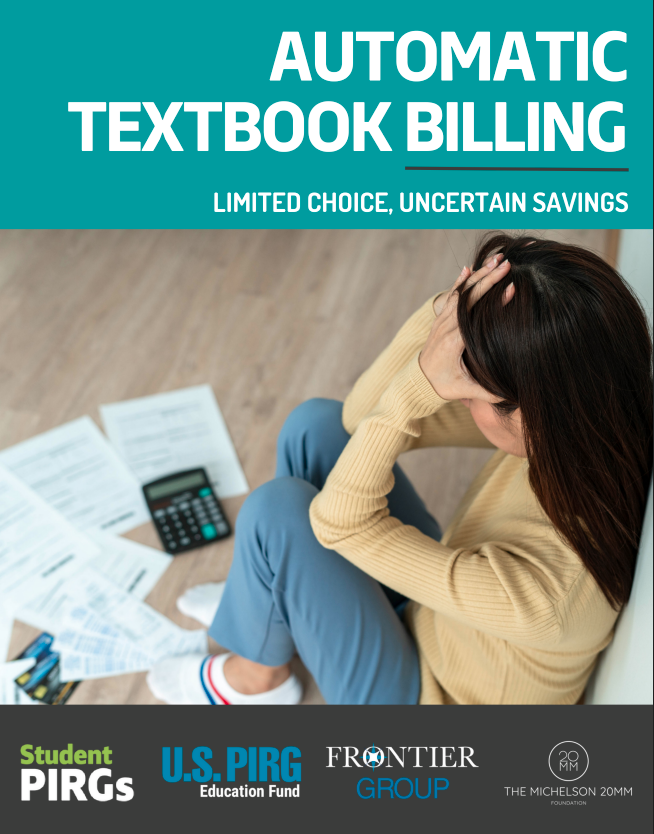
Figure 4. Cover of Automatic textbook billing: Limited choice, uncertain savings (Student PIRGs, 2024). https://studentpirgs.org/assets/uploads/2024/06/PIRG-Automatic-Textbook-Billing-June-2024.pdf
Once “student success” is defined through vendor dashboards and platform engagement, the next step is predictable: make the platform the default.
That is exactly what automatic textbook billing models do, including Inclusive Access, Equitable Access, and Affordable Access. These programs are widely criticized because the default is often automatic billing with opt-out structures that can undermine meaningful choice, especially when homework platforms are tied to paid access. (InclusiveAccess.org, n.d.; SPARC, n.d.)
Student advocates have argued these systems can lock students into an uncompetitive market and limit price-shopping. Contract reviews and policy discussions have raised recurring concerns about incentives, transparency, and student agency. (Student PIRGs, 2024; SPARC, n.d.)
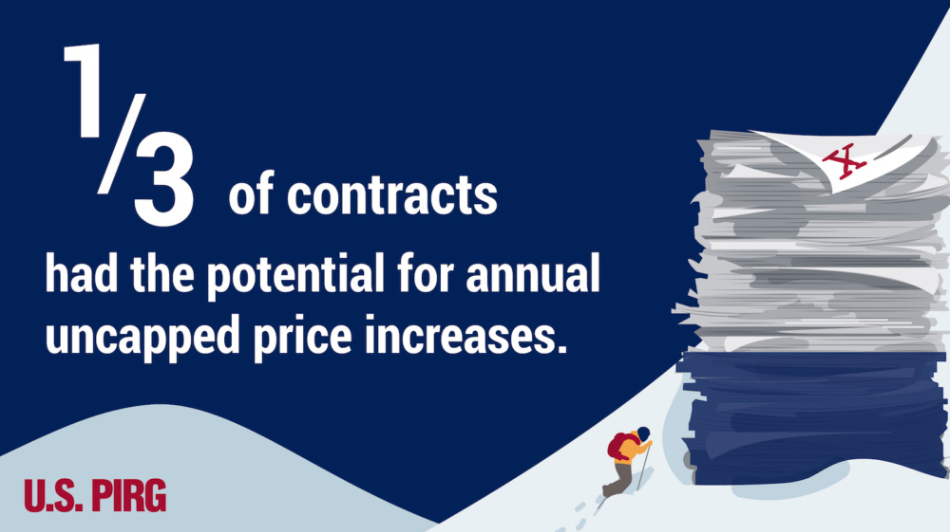
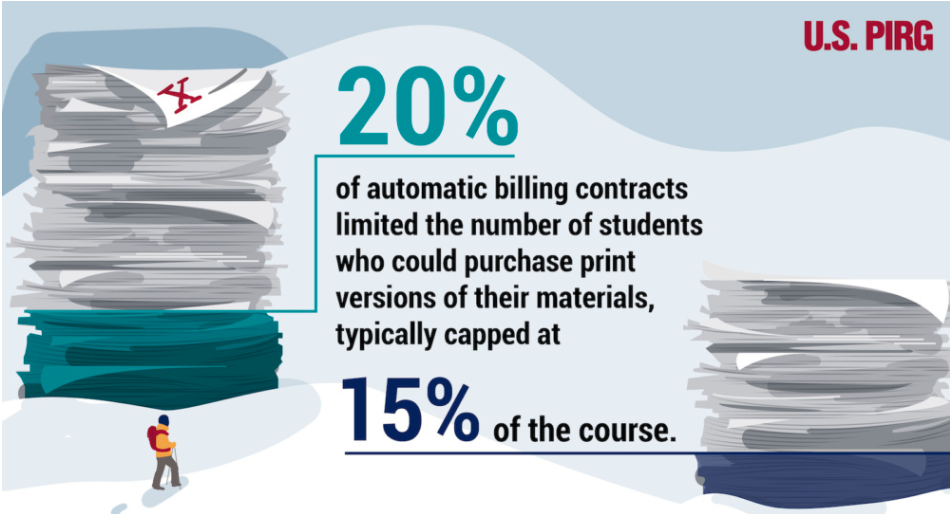
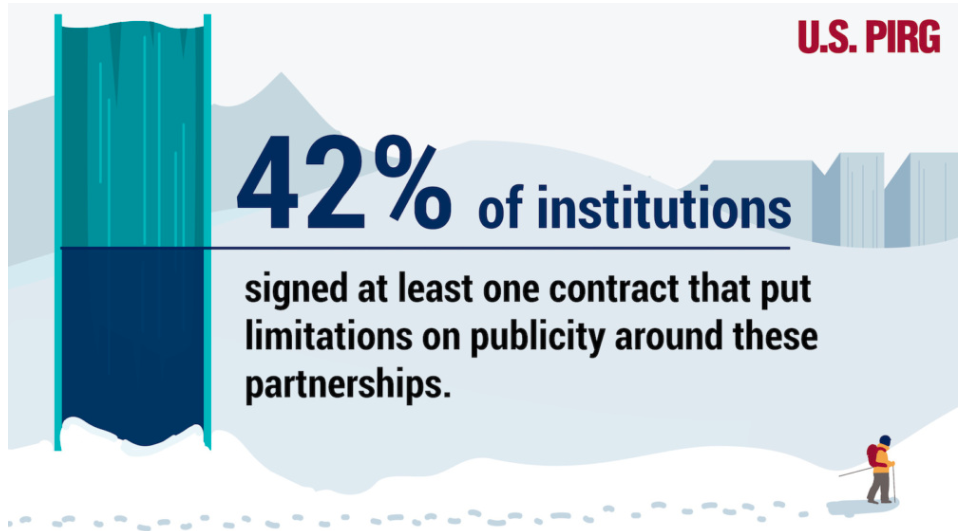

Illustrations by Danielle Curran.
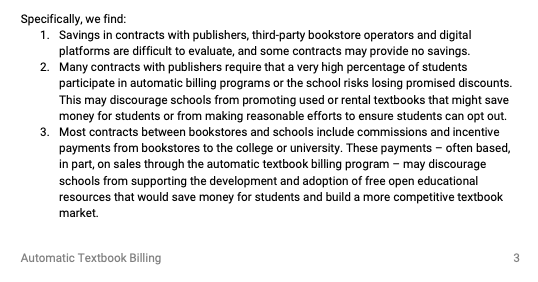
Figure 10. Findings excerpt from Automatic textbook billing: Limited choice, uncertain savings (Student PIRGs, 2024). https://studentpirgs.org/assets/uploads/2024/06/PIRG-Automatic-Textbook-Billing-June-2024.pdf
Here’s what this really comes down to:
When a corporation writes your decision framework, you will get a decision that benefits the corporation.
That does not mean the product is automatically bad. It means the document is not neutral. It is marketing. And marketing always has an outcome in mind. (SPARC, n.d.)
7) Academic freedom is the missing column in McGraw Hill’s table
OER is not just “free content.” It is faculty expertise made durable and shareable.
Academic freedom protects the integrity of teaching and learning because faculty are the disciplinary experts, responsible for what and how students learn. (American Association of University Professors [AAUP], 1940/1970)
OER’s practical superpower is that it turns that expertise into something you can actually do something with. The legal permissions to retain, revise, and remix are not abstract ideals, they are instructional power: the power to localize examples, update rapidly as knowledge shifts, remove harmful or outdated framing, add culturally responsive context, and design around the students in front of you instead of around a platform’s product roadmap. (BCcampus, n.d.; University of Texas at Austin, n.d.)
Publishers are not villains for having incentives. They are businesses. But business incentives are not pedagogy, and marketing materials are not peer review. (AAUP, 1940/1970)
8) What the research says, because we should care about outcomes
The persistent myth the guide quietly feeds is “free equals lower quality.” The research base does not support that as a general claim. Meta-analyses comparing courses using OER to those using traditional materials find small but consistent benefits in course grades and, more importantly, in completion and pass rates. A 2024 meta-analysis of 26 studies found OER courses were associated with higher course grades and higher completion rates, including higher rates of earning at least a C and at least a D. (Cho & Permzadian, 2024) A broader synthesis of OER and open practices also finds positive effects on learning achievement across contexts. (Tlili et al., 2023)
And the most meaningful outcomes often show up where institutions say they are trying to move the needle: equity gaps and high-DFW courses. Large-scale reviews of OER adoption report reductions in DFW grades that are larger for Pell-eligible students and other historically underserved populations, along with improvements in course grades. (Open Education Group, n.d.) In other words, OER does not just save money. It changes who gets through the course.
That is the cost avoidance story the “median price” framing cannot tell. When students have day-one access, when materials are not rationed, and when faculty can iteratively improve resources based on actual learner needs, the benefits compound. Institutions are not simply purchasing a discounted product for one semester. They are building durable teaching infrastructure and reinvesting value back into students and the university rather than extracting it as recurring platform revenue. Frameworks for calculating OER savings and ROI increasingly emphasize this distinction between one-time price reduction and long-term institutional value. (WCET, 2022)
OER is also a pedagogical technology, not just a cheaper substitute. Its permissions make innovative teaching possible: students can contribute to knowledge creation, revise and improve course materials, and see themselves represented as participants rather than passive consumers. Platform courseware can support learning, but it cannot offer that kind of academic freedom by design, because openness is not a feature, it is a different governance model. (Tlili et al., 2023; Open Education Group, n.d.)
OER is not automatically good. Commercial courseware is not automatically bad. But the storyline that OER is inherently risky and inferior is not evidence-based. It is market-based. (Cho & Permzadian, 2024; Tlili et al., 2023)
The ethical takeaway
If your institution is genuinely weighing OER vs McGraw Hill Affordable Access, do not start with their table. Start with yours:
What do students keep access to after the course ends?
Is billing opt-in or opt-out, and is opting out functionally possible if assignments are tied to the platform? (InclusiveAccess.org, n.d.; SPARC, n.d.)
What data is collected, retained, and shared? (Privacy Rights Clearinghouse, 2024)
What accessibility documentation exists, and what are the known exceptions? (U.S. Department of Justice, 2024)
What would happen if we invested the same dollars into OER support: instructional design time, library support, faculty learning communities, and accessibility workflows?
Because this is not just about price. It is about governance.
It is about who gets to define quality, who controls the learning materials, and what students are required to trade for access: money, data, autonomy, and the right to keep what they paid for.
And it is about academic freedom in its most practical form: whether faculty expertise shapes the course, or whether the course quietly reshapes itself around a platform.
That is not a technicality. That is power. And we should treat it like it matters.
References
American Association of University Professors. (1940/1970). 1940 statement of principles on academic freedom and tenure with 1970 interpretive comments. https://www.aaup.org/reports-publications/aaup-policies-reports/policy-statements/1940-statement-principles-academic
BCcampus. (n.d.). OER definition (Faculty OER toolkit). https://pressbooks.bccampus.ca/facultyoertoolkit/chapter/oer-definition/
Cho, K. W., & Permzadian, V. (2024). The impact of open educational resources on student achievement: A meta-analysis. International Journal of Educational Research, 126, Article 102365. https://doi.org/10.1016/j.ijer.2024.102365
InclusiveAccess.org. (n.d.). Opt-out or drop out? https://www.inclusiveaccess.org/facts/opt-out-or-drop-out
McGraw Hill. (n.d.). Open educational resources (OER) vs. McGraw Hill (MH) affordable access model: Buyer’s guide [PDF]. https://www.mheducation.com/content/dam/mhe/highered/documents/affordable-access/buyers-guide-affordable-access-model-vs-open-educational-resources.pdf
Open Education Group. (n.d.). The Review Project. https://openedgroup.org/the-review-project/
Privacy Rights Clearinghouse. (2024, November 19). Paying twice to learn: How higher education students may be forced to sacrifice privacy for digital learning tools [Report]. https://privacyrights.org/resources-tools/reports/paying-twice-learn-how-higher-education-students-may-be-forced-sacrifice
SPARC. (n.d.). Examining automatic textbook billing. https://sparcopen.org/our-work/automatic-textbook-billing/
Student PIRGs. (2024, June 13). Automatic textbook billing: Limited choice, uncertain savings. https://studentpirgs.org/2024/06/13/automatic-textbook-billing-2/
Tlili, A., Garzón, J., Salha, S., Huang, R., Xu, L., Burgos, D., Denden, M., Farrell, O., Farrow, R., Bozkurt, A., Amiel, T., McGreal, R., López-Serrano, A., & Wiley, D. (2023). Are open educational resources (OER) and practices (OEP) effective in improving learning achievement? A meta-analysis and research synthesis. International Journal of Educational Technology in Higher Education, 20, 54. https://doi.org/10.1186/s41239-023-00424-3
University of Texas at Austin. (n.d.). Faculty guide to use of open educational resources (OER). https://provost.utexas.edu/initiatives/faculty-guide-open-educational-resources/
U.S. Department of Justice. (2024). Nondiscrimination on the basis of disability; accessibility of web information and services of state and local government entities. Federal Register, 89, 31320. https://www.federalregister.gov/documents/2024/04/24/2024-07758/nondiscrimination-on-the-basis-of-disability-accessibility-of-web-information-and-services-of-state
UCF OER Starter Guide. (n.d.). The 5 permissions of OER use. https://pressbooks.online.ucf.edu/oerstarterguideatucf/chapter/oers-benefits-to-faculty-and-students/
WCET. (2022, March 8). Six OER student cost savings and cost-benefit principles for decision makers. https://wcet.wiche.edu/frontiers/2022/03/08/six-oer-student-cost-savings-and-cost-benefit-principles-for-decision-makers/