Designing for Enterability: Open Education in Practice
A Texas OER Fellowship capstone project on Open Education infrastructure, faculty development, and reusable pathways from interest to implementation
Designing for Enterability: Open Education in Practice is a Texas OER Fellowship capstone project developed from open education work at The University of Texas at Arlington. The project explores how open education can become more enterable through practical curriculum, structured pathways, documentation tools, and reusable program infrastructure.
At the center of the project is a simple idea: many educators are interested in open education, but the path from interest to implementation can feel overwhelming. This project focuses on that “messy middle”: the space where people search for OER, evaluate quality and fit, interpret licenses, consider accessibility, document decisions, and decide what to do next.
Rather than treating that middle work as invisible or informal, this project designs for it.
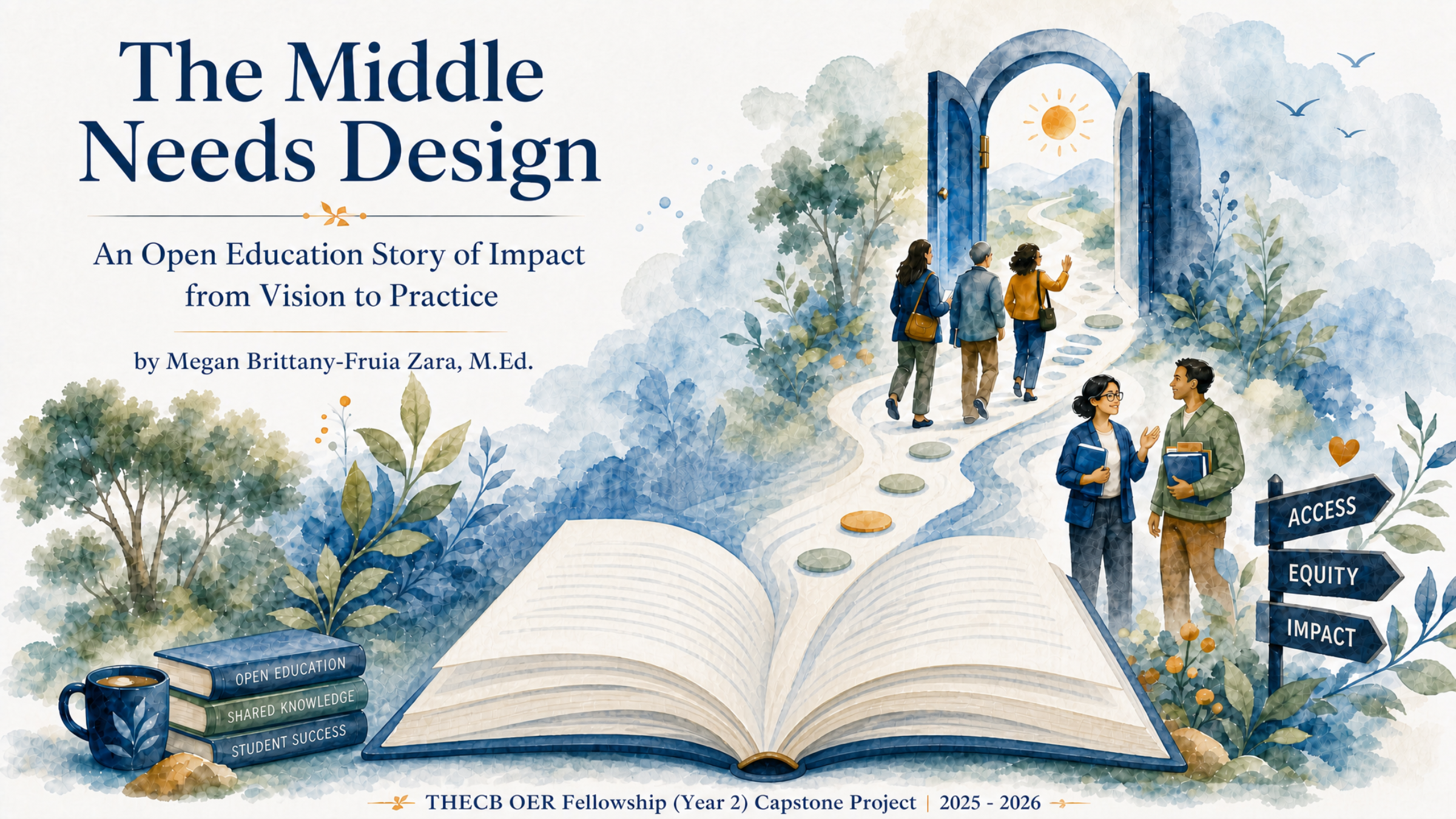
OER Story of Impact, Megan Brittany-Fruia Zara, THECB OER Fellow, 2026
Story of Impact
This Story of Impact shares how my Texas OER Fellowship capstone grew out of open education work at UTA, exploring how practical infrastructure, faculty development, and reusable pathways can make open education more enterable, sustainable, and human-centered.
Open Education in Practice
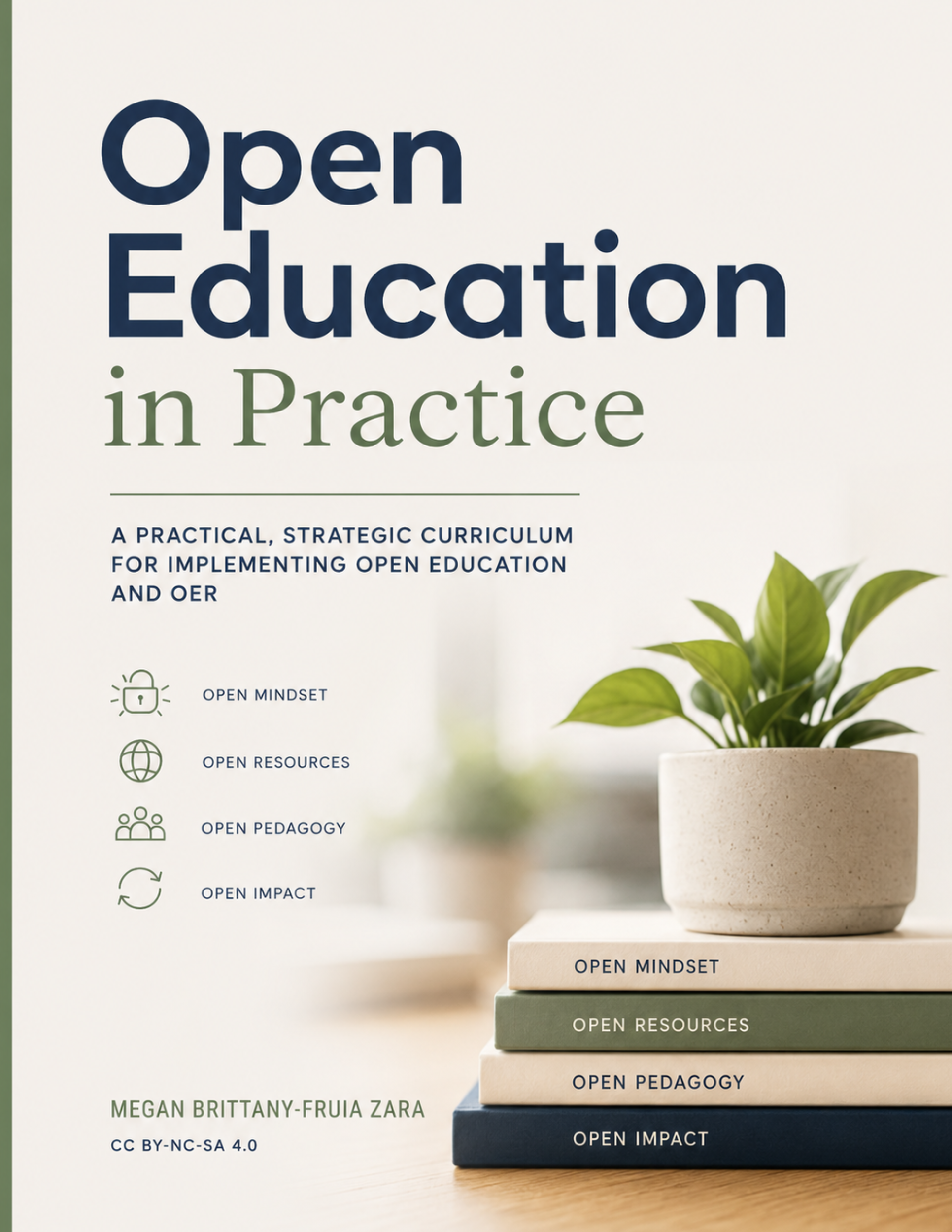
Open Education in Practice: A Practical, Strategic Curriculum for Implementing Open Education and OER is the instructional foundation of this project. The curriculum is designed to help educators, librarians, instructional designers, faculty developers, staff, students, and program leaders move from understanding open education in theory to practicing it in real teaching and learning contexts.
The curriculum includes five major topic areas:
Foundations of Openness
Open Tools and Platforms
Licensing and Copyright
Adopting, Adapting, and Modifying OER
Open Pedagogy and Co-Creation
The curriculum is openly licensed under CC BY-NC-SA 4.0 and may be adapted for noncommercial teaching, learning, faculty development, OER grant preparation, workshops, microcredentials, and institutional onboarding.
Read the Case Study
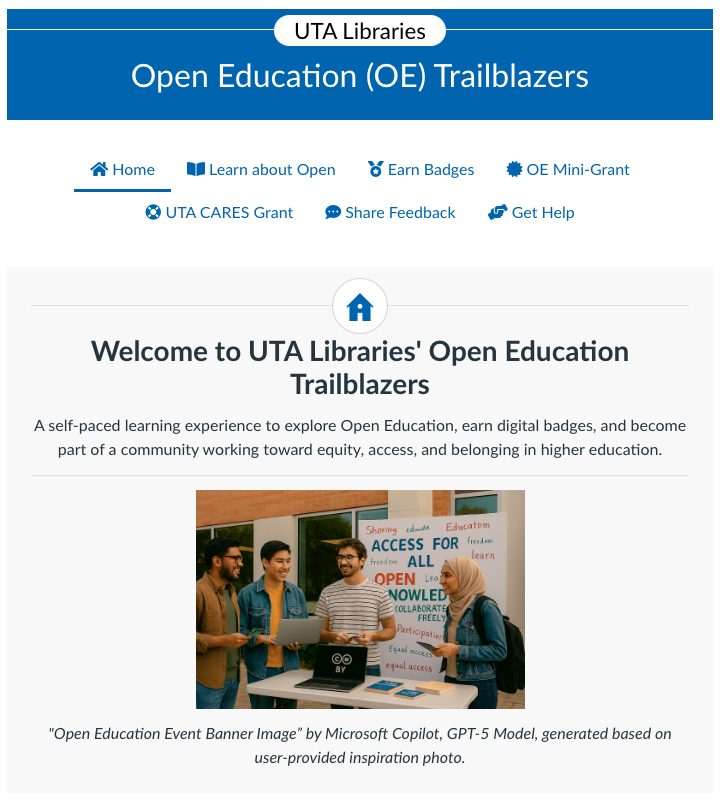
The practitioner case study, Designing for Enterability: A Practitioner Case Study of Open Education Infrastructure at UTA, documents how Open Education in Practice evolved from a curriculum into a connected program architecture.
The case study traces the development of the Open Education Trailblazers Canvas course, four-badge pathway, UTA CARES Grant on-ramp, Open Education Research & Planning Mini-Grant model, Landscape Brief publication process, OER Tracker, documentation tools, and reusable project materials.
It also shares evidence, limitations, adaptation guidance, and reflections on care as infrastructure, documentation-as-scaffolding, and the importance of designing clearer pathways between OER interest and sustained implementation.
Project Resources and Downloads
This project includes multiple resources that can be explored, reused, or adapted depending on your context.
Share Use, Adoption, or Feedback
Are you using, adapting, remixing, teaching with, assigning, importing, or sharing any part of this project? I would love to know how the resources are being used and what questions, critiques, or possibilities they raise in your context.
This form can be used to report adoption or use of the curriculum, Canvas course, Canvas Commons import, IMS Common Cartridge export, project materials folder, mini-grant resources, OER Tracker, Landscape Brief model, documentation tools, case study, or story of impact video. You are also welcome to use it for general feedback, scholarly critique, adaptation ideas, or questions.
Your response may help document the reach and impact of the project and may inform future revisions, presentations, writing, research, or support materials.
Please do not include sensitive student, personnel, or institutional information.

Work With Me
If you are interested in adapting this project for your institution, program, or learning community, I offer support through The Open Practice Academy.
I can help with:
adapting Open Education in Practice for your local context
designing OER faculty development pathways
creating mini-grants, fellowships, or communities of practice
developing badge or microcredential programs
building OER documentation tools and templates
designing Landscape Brief or public documentation processes
supporting open education strategy and implementation
creating humane, sustainable structures for open practice
This work is especially useful for libraries, teaching and learning centers, instructional design teams, OER program leads, higher education institutions, nonprofits, and mission-driven organizations that want to support open education without building everything from scratch.
Recommended Citation
Zara, M. B. F. (2026). Designing for enterability: Open Education in Practice [Capstone project and resource collection]. Megan Zara. https://www.meganzara.com/open-education-in-practice
License
The Open Education in Practice curriculum is licensed under CC BY-NC-SA 4.0. The practitioner case study is licensed under CC BY 4.0. Individual project resources may include their own license notes where applicable.
Accessibility and Questions
If you need an accessibility accommodation, have questions about using these materials, or want to share how you adapted the project, please contact Megan Zara.