Did I Write This? Rethinking Authorship, AI, and What Counts as Thinking
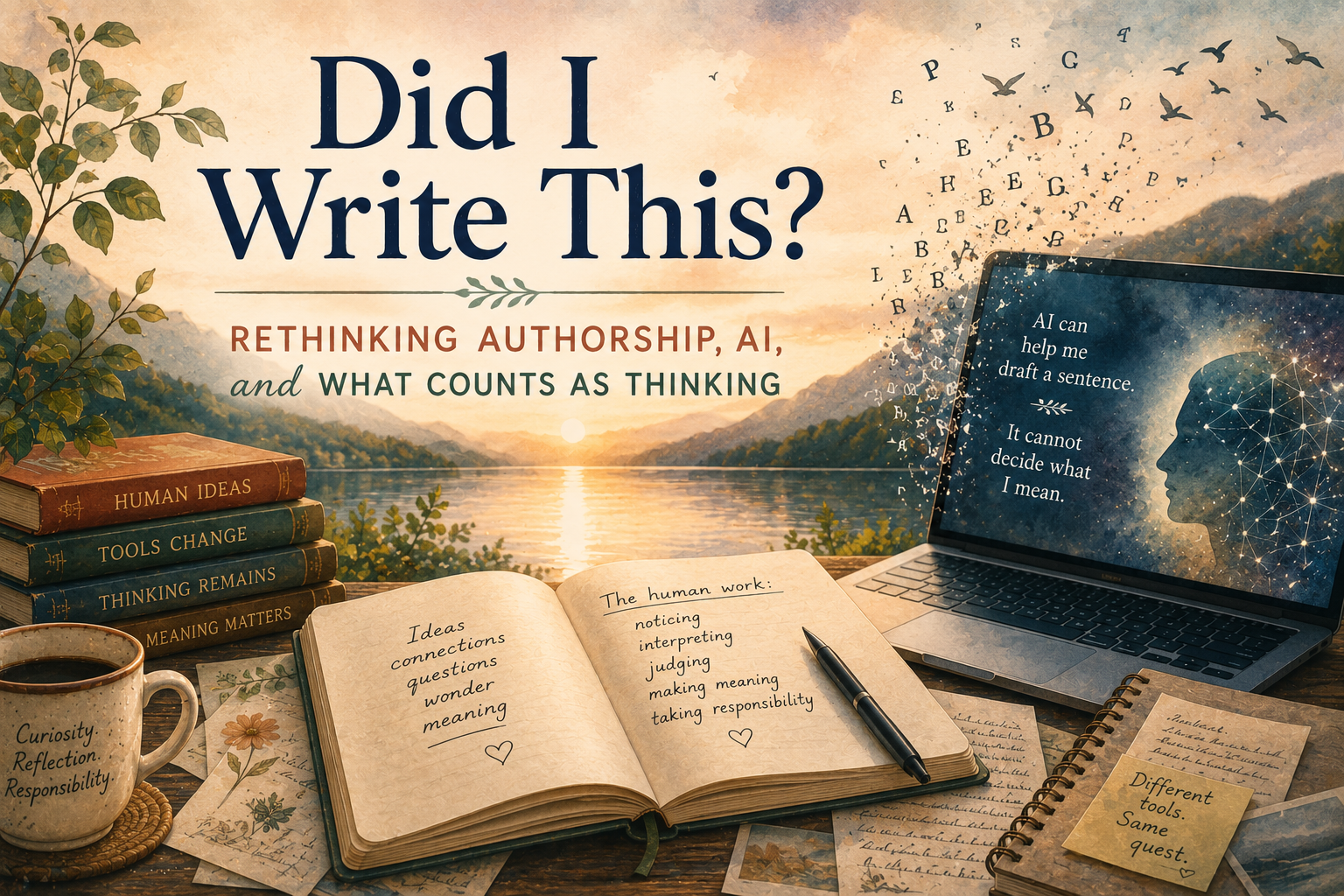
Illustration by Megan Zara, created in collaboration with OpenAI using ChatGPT image-generation tools (2026).
A field note from someone still figuring it out
The Credibility Alibi
Part of me wants to begin this essay by telling you that I earned two degrees and built a strong career before generative AI arrived in everyone’s browser, email, search engine, word processor, phone, refrigerator, and probably toothbrush by next Tuesday.
I want you to know that I could write before AI. I want you to know that I taught writing, designed curriculum, developed professional learning, published work, and built ideas without asking a chatbot to help me find the words. I want to establish that fact early, almost like showing identification at the door, because I suspect it makes me more credible when I tell you that I now use AI nearly every day.
But the more I notice myself wanting to say it, the more uncomfortable I become.
Why should proving that I could write before AI make my current writing more trustworthy? Why does having lived on both sides of this particular technological divide seem to grant me a kind of intellectual alibi? And if I need that alibi, what does it mean for younger people who will never be able to produce one?
My son will not remember a world before generative AI. Many of my future students won’t either. Are we preparing to look at everything they create with a raised eyebrow simply because they grew up surrounded by different tools? Will they spend their lives being asked to prove that they could have done their work the long way, in a world that no longer exists?
That doesn’t feel fair. It also doesn’t mean the concerns about AI are silly, reactionary, or unfounded. Privacy matters. Bias matters. Environmental cost matters. Misinformation matters. Academic integrity matters. The risk of allowing a tool to do so much of our thinking that our own capacities begin to soften around the edges matters.
I’m not interested in pretending those problems disappear because AI happens to help me. I’m also not interested in pretending that every use of AI is the same.
So here I am, in the messy middle, which is apparently where I have decided to set up permanent residence.
How I Actually Use AI
I use AI as a thinking partner, an organizer, a sometimes-editor, a frequent misunderstanding machine, and occasionally a drafter. I don’t usually begin with a blank page and ask it to manufacture an opinion for me. My process tends to begin much earlier and much messier than that. I read. I highlight. I journal. I collect sentences that bother me in useful ways. I write long notes that wander through three metaphors, two memories, one mild existential crisis, and a conclusion I didn’t know I was heading toward.
My brain rarely presents ideas in tidy rows. It gives me constellations. Something from a book connects to a conversation I had six months ago, which connects to a moment from childhood, which bumps into a question about leadership, which suddenly explains why a phrase I’ve been using no longer feels quite right. I often have the shape of an idea before I have its language. Sometimes I can feel the thought clearly but can’t yet hold it still enough to describe it.
That is usually when I bring AI into the conversation.
I might ask what patterns it notices in a brain dump or where my reasoning seems thin. I might ask it to help me distinguish between several ideas I’ve tangled together. I might ask whether I’m making a claim I haven’t earned yet, or whether there are adjacent concepts I should explore before deciding that something is new. Sometimes I ask it to draft from the material I have already provided because seeing my thinking reflected back to me helps me notice where I agree, where I resist, and where I have been misunderstood.
Then I argue with it. A lot.
Sometimes it gives me language that feels startlingly close to what I have been reaching for. Sometimes it makes everything sound like a strategic planning document written by a committee trapped in an airport conference room. Sometimes it becomes too certain, too smooth, too pleased with itself. Sometimes it takes an idea that was alive and complicated and presses it into a sentence so neat that I no longer recognize it.
Those moments are useful too. Explaining why the language is wrong often helps me understand what I believe is right. Resistance is part of my process. So is revision. So is deleting a paragraph that is technically lovely but emotionally false.
Illustration by Megan Zara, created in collaboration with OpenAI using ChatGPT image-generation tools (2026).
AI can produce sentences. It cannot decide which ones I am willing to live inside.
Writing Is More Than Producing Sentences
That distinction has become important to me because we often talk about writing as though it were one indivisible act. Either a person “wrote it” or they didn’t. Either the words emerged directly from the writer’s unaided mind and fingertips, or the work is somehow diluted.
But writing has never been one thing. It includes noticing, wondering, remembering, interpreting, making connections, organizing, choosing, composing, revising, rejecting, clarifying, and taking responsibility. Typing is part of writing, but it isn’t the whole of writing. Drafting is part of thinking, but it isn’t the whole of thinking either.
Much of the current AI conversation collapses all of those activities into a single question: Did you write this yourself?
I’m beginning to think we need better questions.
Whose thinking does this represent? Who decided what mattered? Who questioned the assumptions? Who recognized when something was wrong? Who can explain the choices? Who remains accountable for what has been published?
Those questions do not excuse dishonest use. They make dishonesty easier to see. A person who submits something they don’t understand, haven’t examined, and cannot defend has not done the same intellectual work as someone who uses AI to organize original reflections, interrogates the response, revises extensively, verifies claims, and takes responsibility for the result. The presence of AI does not make those two processes ethically equivalent any more than the presence of a calculator tells us whether someone understands mathematics.
The tool is not the entire story.
Books on Tape and Another Way Into the Story
I keep returning to my own childhood when I think about this. Reading was hard for me, but not because I couldn’t decode words or understand stories. The difficulty was in sustaining attention long enough for the story to remain intact. I would read several pages and realize that my eyes had technically completed their assignment while my mind had wandered off to form a small independent republic.
Then my mom got me books on tape, or audiobooks for the younger crowd.
Books on tape changed my relationship with reading because they changed the route through which I could reach the story. Listening helped me stay with the language. It quieted some of the competing noise and gave the words enough momentum to carry me along. I could follow the plot, inhabit the characters, imagine the world, notice patterns, and think about what the story meant.
People still sometimes insist that listening to an audiobook is not “real reading.” At the most literal level, listening and visually processing print are different activities. Research comparing audiobook listening and print reading suggests that the relationship is more complicated than declaring one format universally equal or superior. Comprehension varies according to the learner, the text, the context, and the purpose. Across the studies reviewed by Singh and Alexander (2022), however, listening and print reading often supported comparable comprehension, particularly when the conditions of learning and the characteristics of the reader were taken into account.
For me, the important truth is not that listening and print reading are identical. They aren’t. It is that the difference in medium did not make my engagement with the ideas fake. The audiobook did not imagine the story for me, interpret it for me, decide what moved me, or carry its meaning into the rest of my life. It reduced a barrier between me and the work.
I sometimes wonder whether AI is doing something similar for my expressive language. It isn’t the same situation, and I don’t want to stretch the analogy until it snaps. But I recognize the feeling of discovering that something I had understood as a personal failure may partly have been a problem of access, process, or cognitive friction.
For years, I could write, but writing often required an extraordinary amount of energy. The ideas were present. The translation was expensive. AI has not given me a mind I didn’t have. It has sometimes given that mind another way out.
When Difficulty Wears an Academic Hat
This is where the moral language around difficulty begins to bother me. We often treat the longest route as the most honest one, as though suffering leaves a faint watermark of authenticity on the page. We praise productive struggle, and sometimes rightly so. Struggling with an idea can deepen understanding. Sitting with uncertainty can keep us from rushing into shallow answers. Learning to structure an argument, revise prose, and tolerate the discomfort of not yet knowing what we mean are genuine intellectual practices.
But not all difficulty is productive struggle. Some difficulty is just friction wearing an academic hat.
If I spend twelve hours trying to organize ideas I already understand because my working memory, attention, or executive functioning makes the process difficult, am I necessarily learning more than I would through a thoughtful dialogue that helps me arrange them? Perhaps sometimes. Perhaps not. The length of the road does not, by itself, tell us what happened along the way.
Illustration by Megan Zara, created in collaboration with OpenAI using ChatGPT image-generation tools (2026).
Is the long way better because it teaches us something, or have we begun to believe it is better simply because it is long?
That question is not unique to AI. Human beings have been suspicious of technologies that alter the work of memory, language, calculation, and knowledge for a very long time.
We Have Been Worried About Thinking Technologies for a Long Time
In Phaedrus, Plato recounts Socrates’ concern that writing would weaken memory and give people the appearance of wisdom without genuine understanding. Writing, in this view, was not merely a neutral tool. It would change how people knew, remembered, and related to knowledge (Plato, ca. 370 B.C.E./1995).
The irony that we know this warning because someone wrote it down is almost too perfect. Humanity has always enjoyed preserving its anxieties with the very technologies causing them.
Later technologies produced their own versions of the same fear. Calculators prompted debates about whether students would lose basic mathematical competence and become unable to reason without a device. Historical research on calculator adoption in U.S. schools documents decades of disagreement among teachers, parents, professional organizations, and policymakers about whether calculators would support mathematical learning or weaken essential skills (Banks, 2011).
Word processors prompted worries about writing and revision. Spellcheck raised questions about whether people would still learn to spell. Search engines made knowledge instantly retrievable and inspired fears that we would stop remembering what we could simply look up.
Again, some of these concerns were not imaginary. Sparrow et al. (2011) found that when people expected information to remain accessible through a computer, they were more likely to remember where to find it than to remember the information itself. The researchers understood this as a form of transactive memory, in which remembering is distributed across people and external systems rather than contained entirely within one individual mind.
Technology changes cognition.
That is not a prediction. It is a description of what technologies do.
Writing changed memory. Print changed access and authority. Calculators changed mathematical practice. Search engines changed retrieval. GPS changed navigation. Smartphones changed attention, communication, photography, boredom, and our previously reliable ability to sit in a waiting room without staring into a glowing rectangle.
AI will change us too.
The question is not whether we can prevent that change by scolding people into using it less. The more useful question is what capacities we want to preserve, what new capacities we might develop, and what kinds of dependence we are willing to accept.
The Myth of the Unassisted Mind
We already live through layers of intellectual assistance. My spelling is shaped by autocorrect. My citations are managed by software. My documents offer grammatical suggestions. Search algorithms influence which sources I encounter first. Digital libraries retrieve texts I might once have spent days locating. Voice-to-text turns speech into writing. Predictive text guesses the rest of my sentence. Much of this technology has become ordinary enough to be nearly invisible.
Generative AI is not identical to those tools. It can generate ideas, fabricate information, imitate style, conceal uncertainty, and produce polished nonsense with breathtaking confidence. It therefore requires forms of judgment that spellcheck does not. But describing it as entirely separate from the longer history of cognitive technologies can make us forget that humans have always thought with tools, environments, texts, and other people.
We have never been as intellectually self-contained as the mythology of the solitary author suggests.
Writers have editors. Scholars have mentors, peers, reviewers, librarians, collaborators, and entire traditions of thought moving quietly beneath each sentence. We borrow forms, inherit language, respond to ideas, and learn how to think by thinking alongside others. Authorship has always involved influence. The presence of influence does not eliminate responsibility. It makes responsible accounting more important.
That is why I keep returning to my impulse to tell you that I earned my degrees before AI. I do want to share that history because it is true and because it shaped how I use these tools. I know what my unaided writing looks like. I have a body of work that predates generative AI. I can compare my processes across time and notice what has changed.
But I do not want that fact to become a purity test.
What Will the Next Generation Have to Prove?
I do not want to imply that people who developed their voices after generative AI became commonplace are permanently less credible. They will need to demonstrate their capacities differently, just as every generation has. We may need new ways to teach and evaluate judgment, understanding, originality, and accountability. We may need more oral defenses, process documentation, reflective accounts, version histories, conversations, and opportunities for people to explain how their work came into being.
“Do it without the tool so I know you can” may still be useful in some learning contexts. There are skills worth practicing independently, particularly while they are developing. I still want students to experience the struggle of forming an argument, choosing evidence, and discovering what they think. I still want to write alone sometimes because I don’t want every private uncertainty immediately answered, organized, or made efficient. Some thoughts need to wander around barefoot before we put them in business casual.
But “do it without the tool” cannot be our only definition of competence in a world where the tool is woven into everything.
We do not establish an engineer’s credibility solely by confiscating the calculator. We ask whether the engineer understands the problem, selected an appropriate method, noticed an implausible result, and can explain the reasoning. We do not establish a researcher’s credibility by requiring a return to the card catalog. We examine the quality of the sources, the logic of the interpretation, the transparency of the process, and the integrity of the conclusions.
Perhaps AI asks us to move from proving independence toward demonstrating judgment.
That shift does not make the standard easier. It may make it harder.
Judgment requires knowing enough to recognize when the tool is wrong. It requires resisting language that sounds convincing but says very little. It requires checking facts, tracing ideas, protecting private information, noticing bias, and refusing to publish something simply because it arrived polished. It requires being able to distinguish between a sentence that is elegant and a sentence that is true.
It also requires honest reflection about dependency. I don’t want to become unable to write without AI. I don’t want to lose the peculiar discoveries that happen when I sit with a thought long enough for it to surprise me. I don’t want my language smoothed into sameness or my uncertainty prematurely resolved. I don’t want convenience to quietly become incapacity.
My Current Map
I try to use AI as a practice rather than an answer. That practice is imperfect, evolving, and occasionally contradictory because I am a person, not an institutional policy document.
| Part of the work | How AI sometimes helps me | What I do not want to surrender |
|---|---|---|
| Noticing and developing ideas | It can reflect patterns across my notes or ask questions that open another path. | My curiosity, experience, attention, and sense of what matters |
| Reflection | It gives me something to respond to, challenge, refine, or reject. | My interpretation and emotional truth |
| Organizing | It can help gather nonlinear thoughts into a possible structure. | My decision about the shape and direction of the work |
| Finding language | It can offer phrasing when I know what I mean but can’t yet say it clearly. | My meaning, voice, and right to say, “No, that isn’t it” |
| Drafting | It can turn extensive notes and dialogue into a provisional whole. | My responsibility to read, revise, verify, and reshape it |
| Critique | It can identify gaps, assumptions, or possible counterarguments. | My judgment about which critiques are valid |
| Final publication | It can support checking and refinement. | My name, my accountability, and my willingness to stand behind the work |
I do not claim that this table solves the ethical problem. It is simply the map I am using right now. Maps change as the terrain becomes clearer.
I also believe disclosure matters, although what responsible disclosure looks like will depend on the context. A private journal entry, a blog essay, an academic article, a student assignment, and a grant application do not carry identical expectations. Transparency should be meaningful, not ceremonial. Saying “AI was used” tells us very little if we don’t also understand what it was used for, what the human contributed, and how the result was evaluated.
I am trying to become more capable of accounting for my process, not merely defending my use.
Kinda Right, Then More Right
That process will keep changing because the technology will keep changing. We will get some things wrong. We will create policies that make sense for six months and then discover that the ground has shifted beneath them. We will overreact in some places and underreact in others. We will have to revise our ethical practices in public, which is uncomfortable because people prefer moral certainty with crisp edges and excellent branding.
Still, I would rather participate in an iterative ethical practice than pretend we can write one final rule that protects us from every possible misuse.
We can try, fail, notice, repair, and try again. We can become kinda right, then more right, without pretending we have arrived at perfectly right.
For me, the boundary between my thinking and AI does not live neatly inside individual sentences. Sometimes I wrote the original sentence. Sometimes AI proposed it. Sometimes we arrived at it through seven rounds of revision, disagreement, clarification, and me saying, “No, you have once again turned me into a brochure.”
The more meaningful boundary lives in judgment and responsibility.
Who brought the experience? Who noticed the question? Who cared enough to pursue it? Who recognized when the answer was shallow? Who made the connections? Who verified the claims? Who decided what stayed? Who is willing to be corrected? Who will stand behind the finished work?
That is where I currently locate the human work.
Illustration by Megan Zara, created in collaboration with OpenAI using ChatGPT image-generation tools (2026).
Maybe credibility has never belonged to the tool. Maybe it has always belonged to the quality of our judgment, the honesty of our process, and the responsibility we take for what we put into the world.
What Counts as Thinking?
I earned two degrees and built a career before generative AI became widely available. That history is part of my story, and it helps me understand the changes in my own practice. But I don’t want it to become the entrance fee younger thinkers must somehow pay before we trust them.
They will think with tools I did not have. They will also face questions I did not have to answer.
Our responsibility is not to condemn them as less credible because their intellectual world looks different from ours. It is to help them become discerning, reflective, capable people within the world they actually inhabit.
I am still deciding what I want to preserve, what I am willing to delegate, and which kinds of struggle continue to teach me. I am still listening for the moment when support begins to feel like substitution. I am still learning how to use a tool that can both expand and flatten, clarify and distort, open a door and quietly offer to walk through it for me.
I don’t have a clean conclusion, which feels appropriate for an essay about resisting clean conclusions.
I know that AI did not teach me how to think. I know I was writing, teaching, creating, and building ideas before it appeared. I also know that its usefulness to me is real. It has helped me move through barriers that once consumed enormous amounts of time and energy. It has helped me hear patterns in my own thinking and find language for ideas that were present but difficult to hold.
That does not make it harmless. It does not make every use ethical. It does not relieve me of the responsibility to keep examining what I am doing.
It simply means that my experience is more complicated than either “AI is cheating” or “AI will save us.”
Most human things are.
Perhaps what counts as thinking has never been determined by whether we worked alone or used the longest possible route. Perhaps thinking is found in the noticing, the questioning, the resistance, the meaning-making, the discernment, and the willingness to remain responsible for what we create.
AI can help me draft a sentence.
It cannot decide what I mean.
References
Banks, S. R. (2011). A historical analysis of attitudes toward the use of calculators in junior high and high school math classrooms in the United States since 1975 [Master’s thesis, Cedarville University]. ERIC. https://eric.ed.gov/?id=ED525547
Plato. (1995). Phaedrus (A. Nehamas & P. Woodruff, Trans.). Hackett Publishing Company. (Original work published ca. 370 B.C.E.)
Singh, A., & Alexander, P. A. (2022). Audiobooks, print, and comprehension: What we know and what we need to know. Educational Psychology Review, 34(2), 677–715. https://doi.org/10.1007/s10648-021-09653-2
Sparrow, B., Liu, J., & Wegner, D. M. (2011). Google effects on memory: Cognitive consequences of having information at our fingertips. Science, 333(6043), 776–778. https://doi.org/10.1126/science.1207745
Behind the Page
This essay emerged through an iterative conversation between ChatGPT and me. The questions, experiences, arguments, examples, and final judgments are my own. AI was part of my thinking process—not as a replacement for it, but as a dialogue partner.
Throughout the writing process, I used AI to help me identify patterns across journal entries, organize ideas, surface counterarguments, locate scholarly sources for verification, refine language, and challenge assumptions. I also rejected, rewrote, and substantially revised many of its suggestions. Every claim, quotation, citation, and conclusion was reviewed, verified, and intentionally chosen before publication.
The illustrations accompanying this essay were created from concepts, symbolism, and creative direction that I developed using OpenAI’s image-generation tools.
I don’t view AI as the author of this work. I view it as one tool among many—alongside books, conversations, journals, editors, search engines, and years of lived experience. As I argue throughout this essay, I believe authorship is less about who or what produced a sentence and more about who takes responsibility for its meaning.
This acknowledgment is part of an ongoing practice. Like the technology itself, it will continue to evolve as I learn.