What If Potential Follows Encouragement?
📝 Field notes on expectations, performance, and the small ways we may help create what we think we’re simply observing.
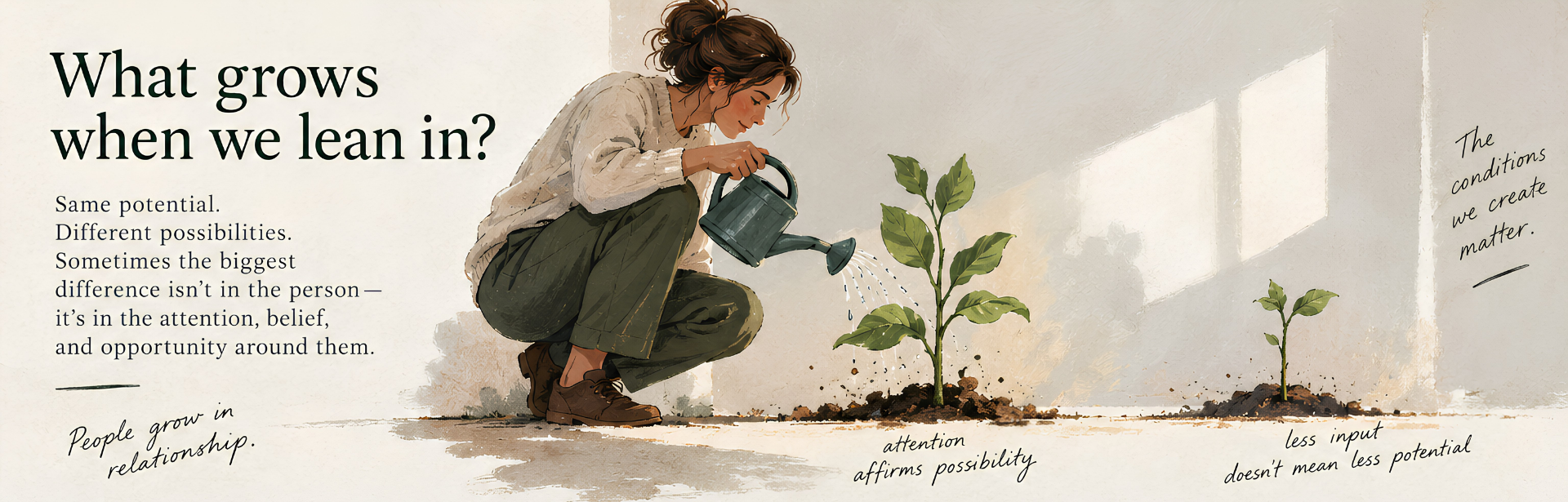
Most of us can name a teacher who made us feel like we were good at something.
Maybe you turned in an essay and they wrote, “You have a voice,” in the margin. Maybe you asked a question in science class and, instead of simply answering it, they got excited and asked what you thought. Maybe they handed you a harder book, invited you to join something, asked you to help another student, or told you that you thought like a mathematician.
The moment itself may have been tiny. The memory usually isn’t.
Sometimes those moments become part of the stories we tell about ourselves years later: That’s when I realized I was a writer. That’s when I started thinking I could become a scientist. That’s the first person who made me think I might actually be good at this.
Unfortunately, most of us can name another teacher, too.
The teacher who seemed impatient when we didn’t understand. The one who stopped calling on us. The one who sounded surprised when we got something right. The teacher whose face, tone, or attention somehow communicated something they may never have actually said: This isn’t really for you.
I’ve been thinking about those teachers lately because of two research articles I’ve been reading for my doctoral work, one from education and one from organizational leadership. I’m still very much thinking my way through this, but together they have me wondering about something I hadn’t quite had language for before.
What if encouragement doesn’t simply follow evidence of potential? What if, sometimes, evidence of potential follows encouragement?
The people we think are good at something get a different version of us
Let’s start in a classroom.
Imagine you’re teaching and two students raise their hands.
You already know that the first student usually gives thoughtful answers. When you call on her and she starts stumbling through an idea, you wait. You tilt your head. Maybe you say, “Keep going.” When she finally gets the thought out, it isn’t quite right, but there’s something interesting in it, so you ask a follow-up question.
The second student hasn’t been doing particularly well. When you call on him, he starts stumbling through an answer, too. You can tell he’s headed in the wrong direction, so you help him out. Maybe you rephrase the question. Maybe you call on someone else so he doesn’t have to sit there struggling.
Neither response is cruel. In fact, the second one might come from kindness.
But notice what happened.
One student got time, intellectual space, curiosity, and the opportunity to work through uncertainty. The other got rescued.
If that happens once, probably nothing much happens.
But what if it happens hundreds of times?
Research on teacher expectations has been asking versions of this question for decades. Gentrup et al. (2020) describe what researchers call teacher expectancy effects. In plain language, teachers form expectations about what students are capable of, those expectations can influence how teachers interact with students, and those interactions may contribute to later differences in student performance.
Gentrup et al. (2020) studied more than 1,000 first-grade students and found that teachers’ expectations were not completely explained by students’ existing achievement, cognitive ability, motivation, and background. More importantly, inaccuracies in those early expectations predicted students’ achievement later in the school year, even after the researchers accounted for those other factors.
In other words, what teachers expected mattered.
That doesn’t mean teachers single-handedly determined children’s achievement, and it doesn’t mean every expectation was wrong. It does mean the relationship between “what this student can do” and “what I think this student can do” is more complicated than we might like it to be.
Teacher expectations don’t stay inside our heads
This is where the research becomes especially useful for actual practice.
Gentrup et al. (2020) describe four broad ways previous research suggests teacher expectations can show up in classroom behavior: input, output, feedback, and climate.
Those words sound research-y, but the classroom versions are incredibly ordinary.
Input is what I give you. Do I give you challenging material and complex explanations because I believe you can handle them, while simplifying things more quickly for someone I perceive as struggling?
Output is what I allow you to give me. Do I call on you? Do I wait long enough for you to answer? Do I give you opportunities to explain your thinking, revise an idea, lead something, or show what you know?
Feedback is how I respond to your performance. Is my feedback specific enough to help you improve? Am I talking to you about your thinking and your work, or am I mostly correcting your behavior?
And then there is climate: the warmth and respect contained in the interaction itself (Gentrup et al., 2020).

That last one is the part I keep coming back to.
Because climate is harder to put on a lesson plan.
It’s the smile. The sigh. The extra question. The way I say, “That’s interesting.” Whether I look curious or frustrated when you get something wrong. Whether I seem energized by your ideas. Whether I give you time to find the words. Whether I assume your mistake means you don’t understand, or whether I become interested in figuring out what you do understand.
These are tiny relational signals, and I wonder how often we notice ourselves sending them.
Now move the same interaction into a workplace
This is where the second article complicated things for me.
Leadership researchers use a term called leader-member exchange, usually shortened to LMX. The basic idea is much simpler than the terminology: managers develop different relationships with different employees.
Of course they do.
You probably don’t communicate with every person you supervise in exactly the same way. You may trust one employee to take a project and run with it while another needs more guidance. One person may be the first person you think of when a complicated problem lands on your desk. Someone else may have regular check-ins with you because they’re still developing.
Han et al. (2021) studied what happens when leaders develop different-quality relationships with members of the same team, something called LMX differentiation. They were particularly interested in why those relationships were different. Their findings suggest that differentiation based on employee performance can function differently within a group than differentiation based on a leader simply liking some employees more than others.
That distinction makes sense to me. Performance matters. Expertise matters. Readiness matters. If one person has demonstrated that they can safely manage a complex project and another hasn’t, I don’t think fairness requires pretending those differences don’t exist.
But reading this research alongside the classroom study made me stop at a different question:
What exactly are we allowing performance to determine?
A promotion? A bonus? Responsibility for a complicated project? Those are relatively easy for me to understand.
But what about my patience?
My enthusiasm?
My curiosity about your ideas?
How much time I’m willing to spend helping you work through a problem?
Whether I assume your mistake is an anomaly or evidence that you aren’t ready?
Whether I give you another chance?
Whether I challenge you because I believe you’re capable of more?
Whether I enjoy mentoring you?
Those aren’t formal workplace resources, but I’m increasingly interested in the possibility that they are relational resources.
I’m starting to think about “relational investment”
I don’t yet know where this idea will land in my scholarship. That’s part of why I write Field Notes: I want a place to think in public while the questions are still forming.
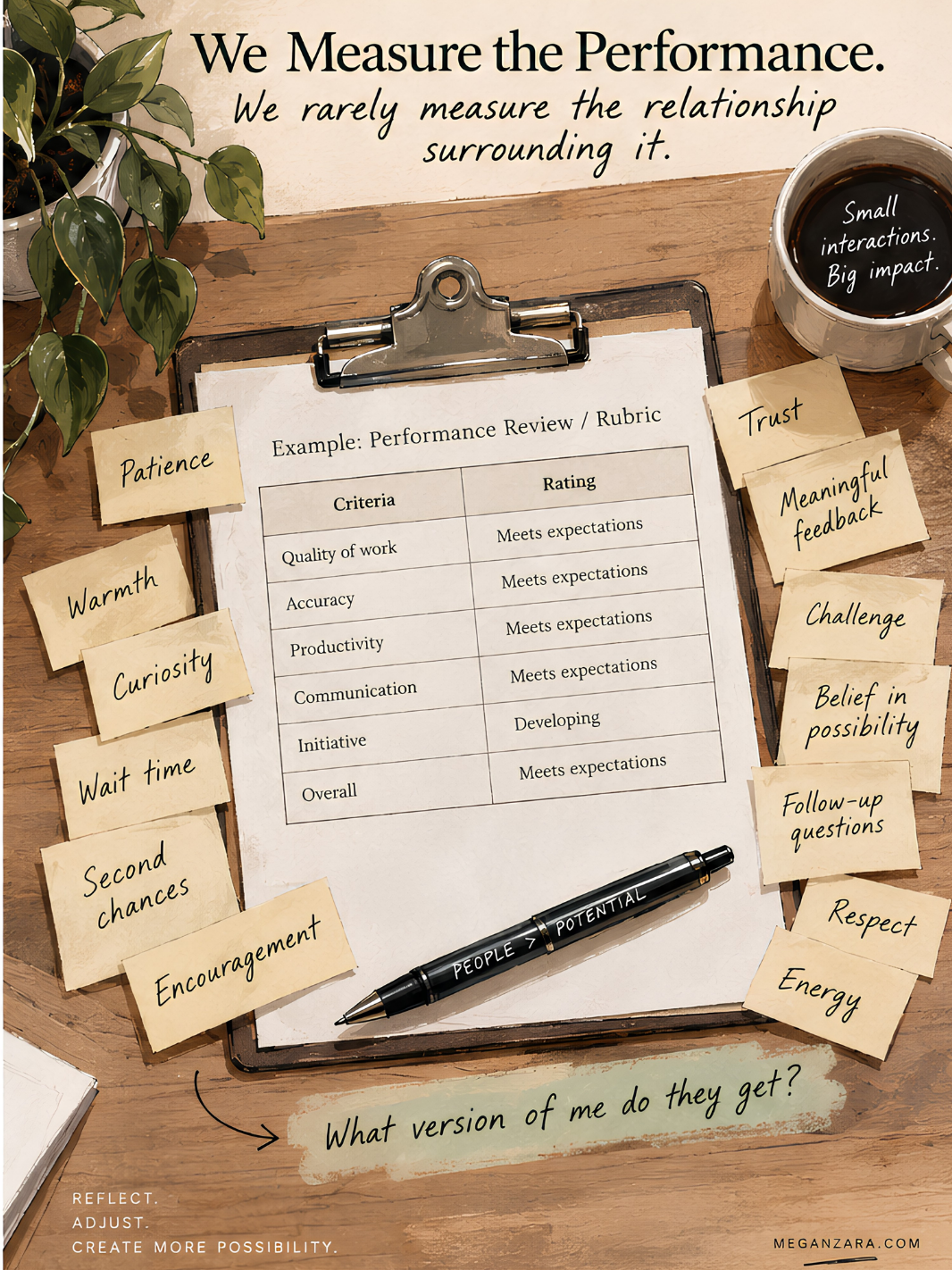
Right now, I’ve been using the phrase relational investment in my own notes to describe something I’m trying to understand: the attention, patience, warmth, trust, challenge, encouragement, responsiveness, and developmental energy that we give another person.
I’m particularly interested in what happens when that investment becomes performance-contingent, meaning that people receive more of it after they demonstrate that they’re already good at something.
Imagine two new employees, Maya and Jordan.
Maya gives a fantastic presentation during her first month. Her manager is impressed. A few weeks later, an interesting project comes up and Maya comes to mind. During meetings, when Maya starts explaining an idea that isn’t completely formed yet, the manager asks questions and helps her develop it. Maya gets detailed feedback because the manager knows she’ll do something with it. Eventually, she gets invited into more complicated conversations.
Jordan’s first presentation doesn’t go nearly as well.
Maybe Jordan really does have less skill right now. Maybe they’re nervous. Maybe presentations are new to them. Maybe they’re still learning the unwritten language of this organization. Maybe something outside of work has consumed half their available cognitive bandwidth.
Nobody decides Jordan isn’t worth developing.
The manager simply responds to the evidence available.
Jordan gets the safer assignment next time. When an idea isn’t fully formed, the manager doesn’t pursue it. When Jordan struggles, the manager steps in sooner. When another interesting project appears, Maya comes to mind first because Maya has demonstrated that she can handle it.
Six months later, Maya may genuinely be better at the work than Jordan.
But now I want to know: How much of the difference we’re observing at six months is the same difference we observed at one month?
Because Maya didn’t just spend five months performing. She spent five months being trusted, stretched, questioned, encouraged, included, and given opportunities to practice increasingly difficult work.
The manager wasn’t standing outside the process measuring Maya’s potential.
The manager was part of Maya’s environment while that potential developed.
This gets especially complicated when there isn’t a right answer
One detail from the education study has really stayed with me. Gentrup et al. (2020) found that teacher expectancy effects were larger in language than in mathematics. They offer several possible explanations, one of which is that language achievement leaves more room for interpretation, while many mathematics problems have clearly correct or incorrect answers.
That immediately made my educator brain light up.
Think about the difference between grading a multiplication problem and responding to a student’s writing.
With multiplication, I can see that the answer is incorrect. With writing, I’m making all kinds of judgments. Is this insightful? Is this sophisticated? Does this student have a strong voice? Is this argument promising? Is this child “a good writer”?
The more subjective the outcome, the more room there is for me to interpret what I’m seeing.
And here is the part that bothers me: the areas that require the most interpretation may also be the areas where people most need encouragement while they’re developing.
Writing. Creativity. Leadership. Critical thinking. Communication. Problem-solving. Strategic thinking.
Even workplace concepts like “leadership potential,” “professionalism,” “initiative,” or “executive presence” require someone to interpret another person’s behavior and decide what it means.
A child isn’t a finished scientist when we first ask them to think scientifically. A new teacher isn’t a finished educator. A first-time manager isn’t a finished leader. A doctoral student isn’t a finished scholar. Someone writing a terrible first draft may still be a writer.
People need room to be bad at things they are becoming good at.
And I wonder whether the people who most need encouragement, patience, feedback, challenge, and room to try again can sometimes receive less of those things precisely because they haven’t demonstrated enough potential to make us want to invest them.
When expectations, relationships, and performance become a loop
This is where the two studies have started connecting for me.
Han et al. (2021) help me think about what happens when performance becomes a basis for different leader-member relationships. Gentrup et al. (2020) help me question whether performance can ever be completely separated from the expectations and interactions surrounding the person performing.
Put those ideas beside each other and I start to see a possible loop.
A person performs well, so I develop higher expectations for them. Because I have higher expectations, I give them more challenging opportunities, more trust, more patience, more attention, or richer feedback. Those experiences help them develop. Their performance improves. I look at that improved performance and think, See? I was right about them.
Meanwhile, someone else struggles early. My expectations adjust downward. Perhaps without realizing it, I give them slightly less challenge, fewer opportunities, quicker corrections, less patience, or fewer chances to recover. They have fewer opportunities to develop. Their performance remains lower. Again, I have evidence that my original assessment was correct.
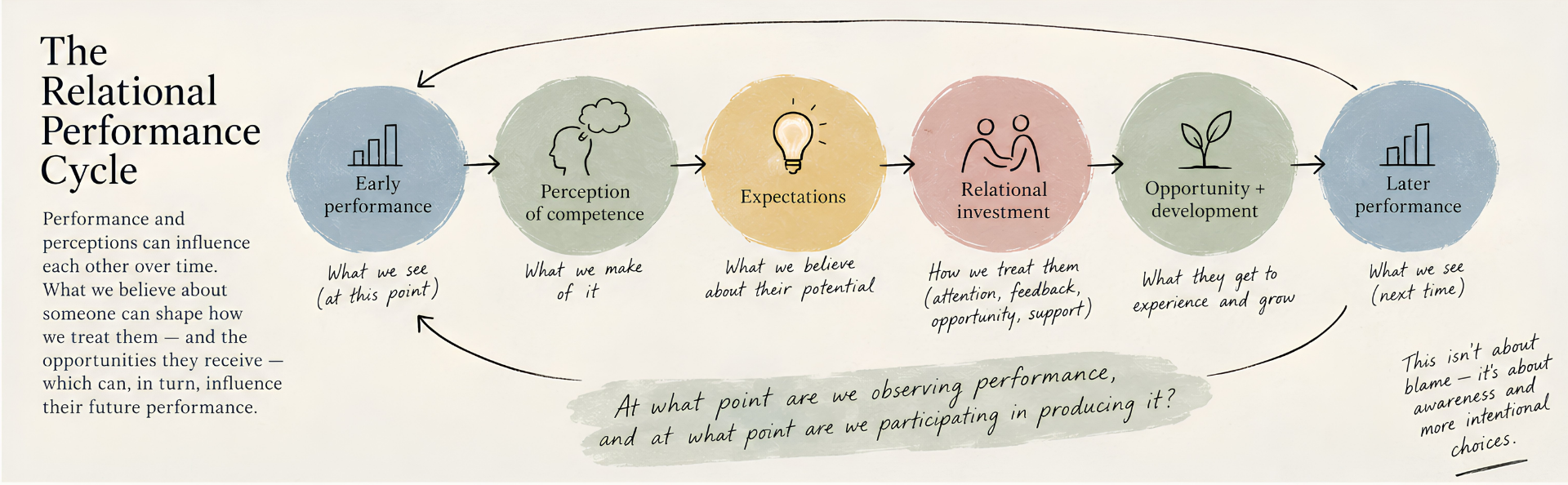
Gentrup et al. (2020) note that teacher expectancy effects may accumulate over time and that systematically biased expectations could contribute to educational inequality. Their study does not demonstrate the entire recursive loop I’m describing here, and Han et al. (2021) are asking a different set of questions in a workplace context. The loop is the question emerging for me as I read these studies together.
I’m wondering whether there might be a kind of relational Matthew effect happening in some classrooms and organizations: small initial advantages attracting relational resources that help create additional advantages, while small initial disadvantages can make those same resources less available.
Maybe encouragement is information, too
There is one more piece of this that feels deeply familiar to me as an educator.
Gentrup et al. (2020) discuss previous research in which children identified teacher feedback as an important source of information about their own achievement.
Of course they do.
Children are constantly trying to figure out who they are. So are adults, frankly.
We tend to think about feedback as the words we give someone: the grade, the comment, the performance review, the coaching conversation. But I wonder whether people are also reading the relationship around those words.
If I spend ten minutes talking through your idea, I’ve told you something.
If I ask you a second question because your first answer interested me, I’ve told you something.
If you make a mistake and I stay curious, I’ve told you something.
If you struggle and I immediately take the difficult work away from you, I’ve told you something then, too.
Eventually, perhaps those interactions stop answering only How did I do? and begin answering much bigger questions: Am I good at this? Do my ideas matter here? Am I someone worth teaching? Does someone like me belong in this room? Could I become the kind of person who does this?
That brings me all the way back to those teachers we remember.
Maybe the reason we remember them so vividly isn’t simply that they accurately identified something that was already inside us.
Maybe, sometimes, they participated in making it possible for us to become it.
So what do we do with this?
I don’t think the answer is to pretend performance differences don’t exist. Teachers have to assess learning. Leaders have to make decisions about readiness, responsibility, expertise, and performance. Nor do I think every struggling student needs easier work or every struggling employee needs endless reassurance. Sometimes care looks like challenge. Sometimes good leadership requires direct feedback.
The question I’m carrying forward is more relational than that.
When someone is struggling, what version of me do they get?
Do I become more curious or less curious? Do I give them room to think, or do I begin thinking for them? Do I offer meaningful challenge, or quietly decide they’re not ready for it? Do I still communicate that I enjoy teaching or leading them? Do I treat a mistake as information about what they need next, or as information about who they are?
And when someone is already thriving, I want to notice what I’m giving them besides opportunity. Am I warmer with them? More patient? More interested? Do I laugh more easily with them? Do I assume good intent when something goes wrong? Do I ask them harder questions because I expect an interesting answer? If so, which of those things are rewards for performance, and which are actually ingredients that help performance grow?
For educators and leaders, I think there are some uncomfortable but useful questions worth carrying into our classrooms, meetings, coaching conversations, and performance reviews:
Who gets the most patient version of me?
Whose mistakes make me curious, and whose mistakes confirm something I already believed?
Who gets to be unfinished around me?
Who gets another attempt without the first attempt becoming their identity?
When I say someone “has potential,” what have I actually observed, and what have I interpreted?
Am I confusing confidence with competence because confidence is easier to recognize?
Who gets challenging work because I believe they’ll rise to it?
Who gets rescued before they have the chance to struggle productively?
Do my strongest performers receive not only more responsibility, but also more warmth, attention, trust, and developmental energy?
If I gave some of those same relational resources to someone I’m less certain about, what might become possible?
I don’t have answers to all of these yet. I’m not sure I want quick answers.
This is an emerging part of my scholarship, and right now I’m less interested in naming a grand theory than I am in learning to see the interaction more clearly. I want to understand how authority figures respond to perceived competence, whether we recognize the small ways our behavior changes, how those differences are experienced by the people on the other side of the relationship, and what happens when those interactions accumulate over time.
For now, though, I keep returning to the teachers people remember decades later. The teacher who said, in one way or another, I see something here. Keep going.
We usually tell those stories as though the teacher spotted something that was already there.
I’m beginning to wonder whether that’s only half the story.
Maybe they saw potential.
And maybe, through the act of seeing it, they also gave it somewhere to grow.
References
Gentrup, S., Lorenz, G., Kristen, C., & Kogan, I. (2020). Self-fulfilling prophecies in the classroom: Teacher expectations, teacher feedback and student achievement. Learning and Instruction, 66, 101296. https://doi.org/10.1016/j.learninstruc.2019.101296
Han, J. H., Liao, H., Han, J., & Li, A. N. (2021). When leader-member exchange differentiation improves work group functioning: The combined roles of differentiation bases and reward interdependence. Personnel Psychology, 74(1), 109–141. https://doi.org/10.1111/peps.12415