There Had to Be More Gentleness in the World
On fidget toys, Paulo Freire, and learning to question what school asks us to become
A Message From Fifth Grade
A few days ago, a message came through ParentSquare from my child’s fifth-grade classroom. Parents were asked to make sure fidget toys and squishy items stayed home. Toys were becoming a distraction, the message explained, and students who continued bringing them would have their behavior calendars signed.
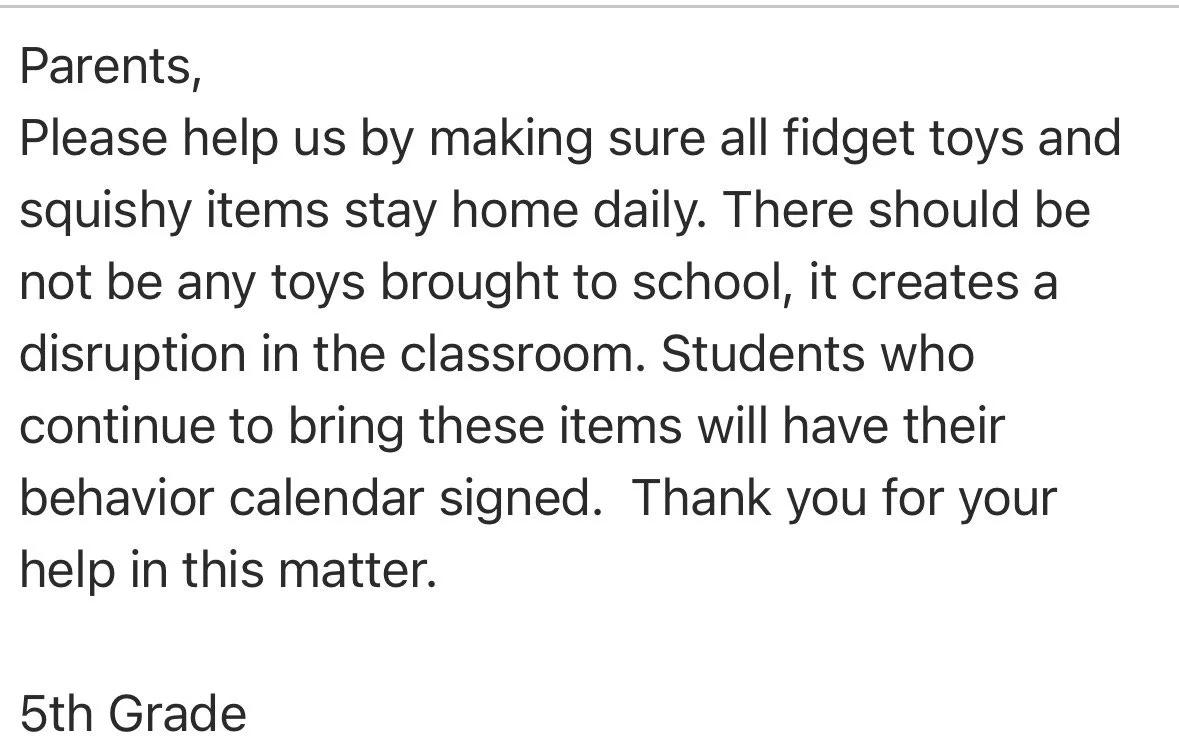
The fifth-grade classroom message that prompted this reflection. Screenshot shared for commentary and reflection; identifying information omitted.
I understood the message immediately. Of course I did. I was a sixth-grade teacher once, and there was a time when I probably would have sent something similar.
Kids bring things to school. Things become toys. Toys get passed around. Someone makes a noise. Someone else wants one. Suddenly you’re trying to explain fractions while a small rubber axolotl is flying across the room.
I understand classroom management.
But as I read the message, something in me resisted it.
I looked around my own desk. I have fidgets everywhere. There are probably seven within reach of me right now. I use them while I’m working. I use them while I’m thinking. I bring things to fidget with when I attend professional learning. I use them when I’m sitting in classrooms as an adult learner. Moving my hands can help me listen, think, regulate, and stay present.
And no one signs my behavior calendar.
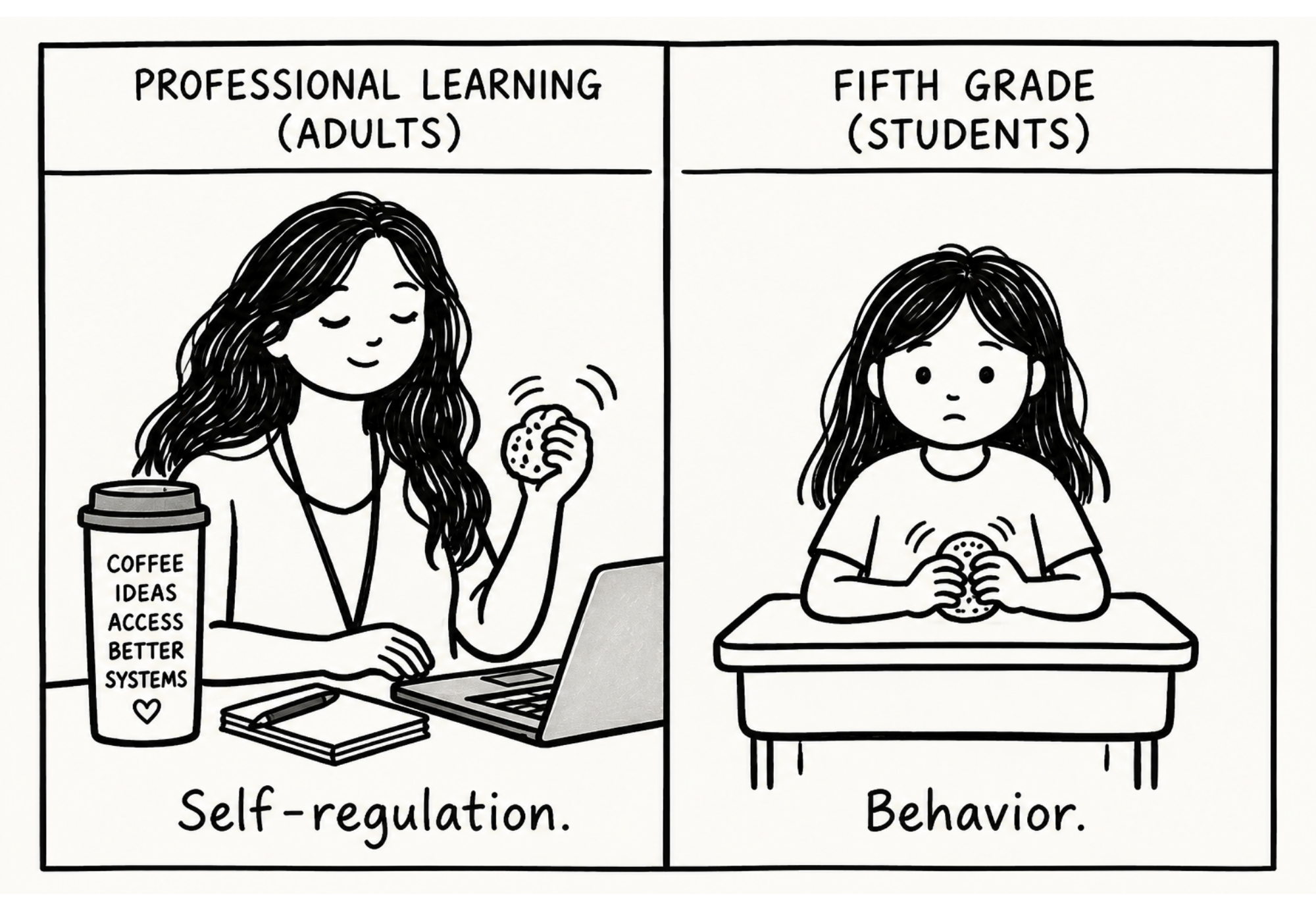
The same regulatory practice can be interpreted very differently depending on who is doing it. Illustration generated with ChatGPT (OpenAI) in collaboration with the author.
The absurdity of that comparison stayed with me. Why do we sometimes expect children to have greater control over their bodies than we expect from adults? More importantly, why is our first educational response so often to remove the thing rather than teach children how to understand themselves in relationship with it?
What If We Taught the Skill?
If I were teaching sixth grade now, I wouldn’t have the same classroom I had then.
I think I would invite students to find something that helped them focus. And then we’d talk about it. What does it feel like when you’re focused? How do you know when your body needs movement? What helps you listen? What makes it harder? How can something help you without making it harder for the person sitting next to you?
We’d practice.
I’d probably create an intentionally low-stakes lesson and tell them, “Okay, today we’re practicing learning with our fidgets.”
And when something didn’t work, we wouldn’t immediately treat that as evidence that the privilege needed to disappear. I’d sit beside the kid with the clicking fidget and say, “Hey, I think that might be helping you, but it’s making it harder for some other people to concentrate. Can we figure out another way to use it? Or maybe there’s something else that would work for you?”
Because that is a skill.
Self-regulation is a skill. Understanding your own body is a skill. Recognizing another person’s needs is a skill. Participating in a community without erasing yourself or everyone around you is a skill.
Why wouldn’t school be a place where we learn those things?
I Didn’t Always Think This Way
I didn’t always think this way. In fact, I entered education believing pretty deeply in blanket rules. Consistency was fairness. Expectations applied to everyone. Good classroom management meant establishing the rules and enforcing them reliably.
That understanding didn’t survive contact with actual children very well.
Something about enacting it always felt slightly wrong.
I didn’t have words for that yet. I didn’t have the experience, confidence, or self-understanding to interrogate what I had been taught about what a classroom was supposed to look like. I certainly didn’t understand my own childhood well enough to recognize why some of those expectations made me uncomfortable.
I only knew there had to be another way.
The Possibility Was the Point
Looking backward, I wonder whether that was part of what pulled me so strongly toward educational technology when I began teaching. I loved the tools, certainly, but I don’t think the technology itself was ever really the point.
The possibility was.
Technology gave me ways to extend things. Support things. Enrich things. Let students approach learning differently. Create instead of simply answer. Explore something beyond what was sitting on the page in front of them.
Every new tool seemed to contain a tiny question:
What if we didn’t have to do it this way?
I didn’t know yet how deeply personal that question was.
What Is Wrong With Me?
As a child, school was extraordinarily uncomfortable for me. Not necessarily the academic content itself, but everything surrounding it. The social expectations. The logistics. The noise. The rules I didn’t understand. The ways everyone else seemed to know what they were supposed to do and how they were supposed to be.
School could feel lonely, abrasive, overwhelming, and confusing.
And when you’re a child, you don’t necessarily have the capacity to look at an institution that enormous and think, Perhaps this environment has been designed around assumptions that don’t fit me.
You think:
What is wrong with me?
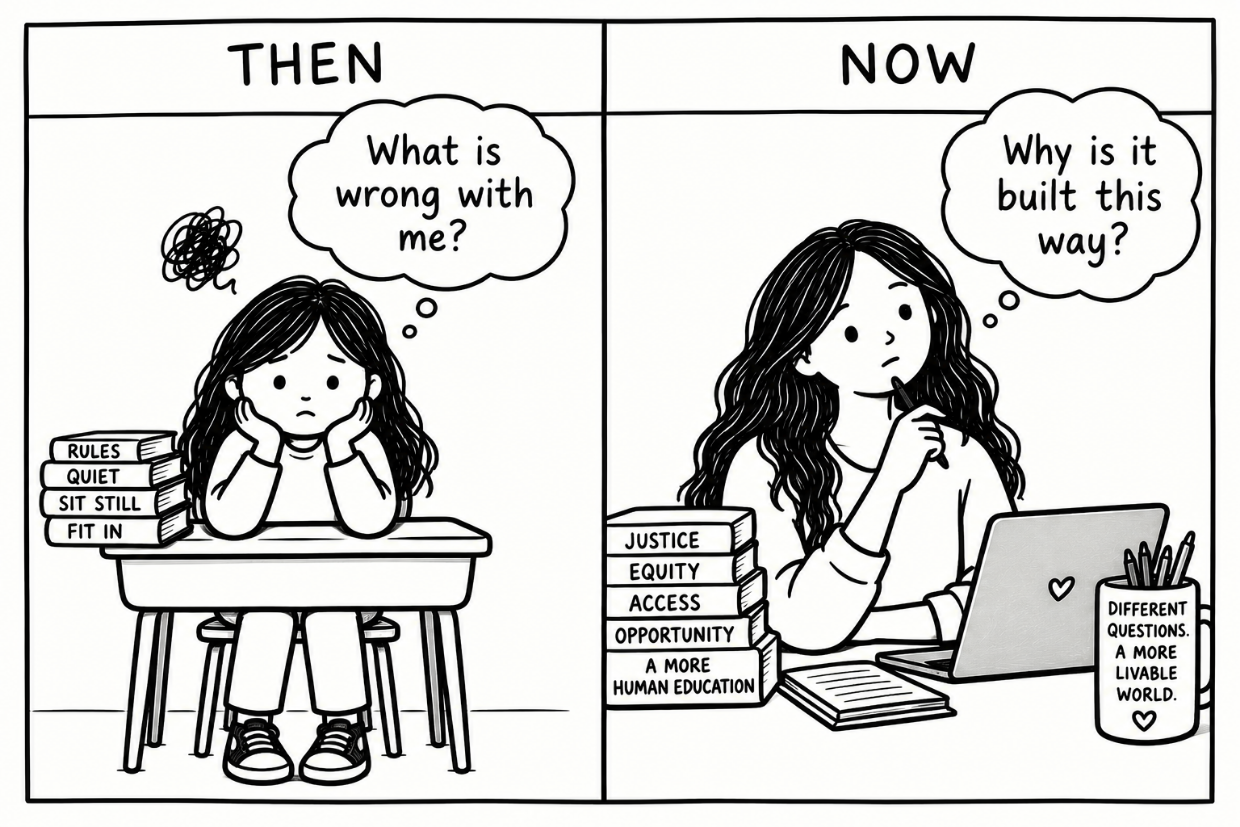
Sometimes the most transformative shift is learning to question the conditions around us instead of locating the problem entirely within ourselves. Illustration generated with ChatGPT (OpenAI) in collaboration with the author.
For a long time, I couldn’t answer that question.
Then I Went to Graduate School
Then I went to graduate school.
At Texas Woman’s University, I encountered faculty and an educational environment steeped in social justice in ways I had never experienced before. For perhaps the first time, education wasn’t simply asking me to learn differently.
It was giving me permission to question learning itself.
And somewhere in that experience, I read Paulo Freire’s Pedagogy of the Oppressed.
I encountered the banking model of education. And I couldn’t unsee it.
I Couldn’t Unknow It
Freire described an educational relationship in which knowledge is treated as something possessed by the teacher and deposited into students. Students become containers. The teacher knows; the students receive. The teacher speaks; the students listen. Knowledge travels in one direction.
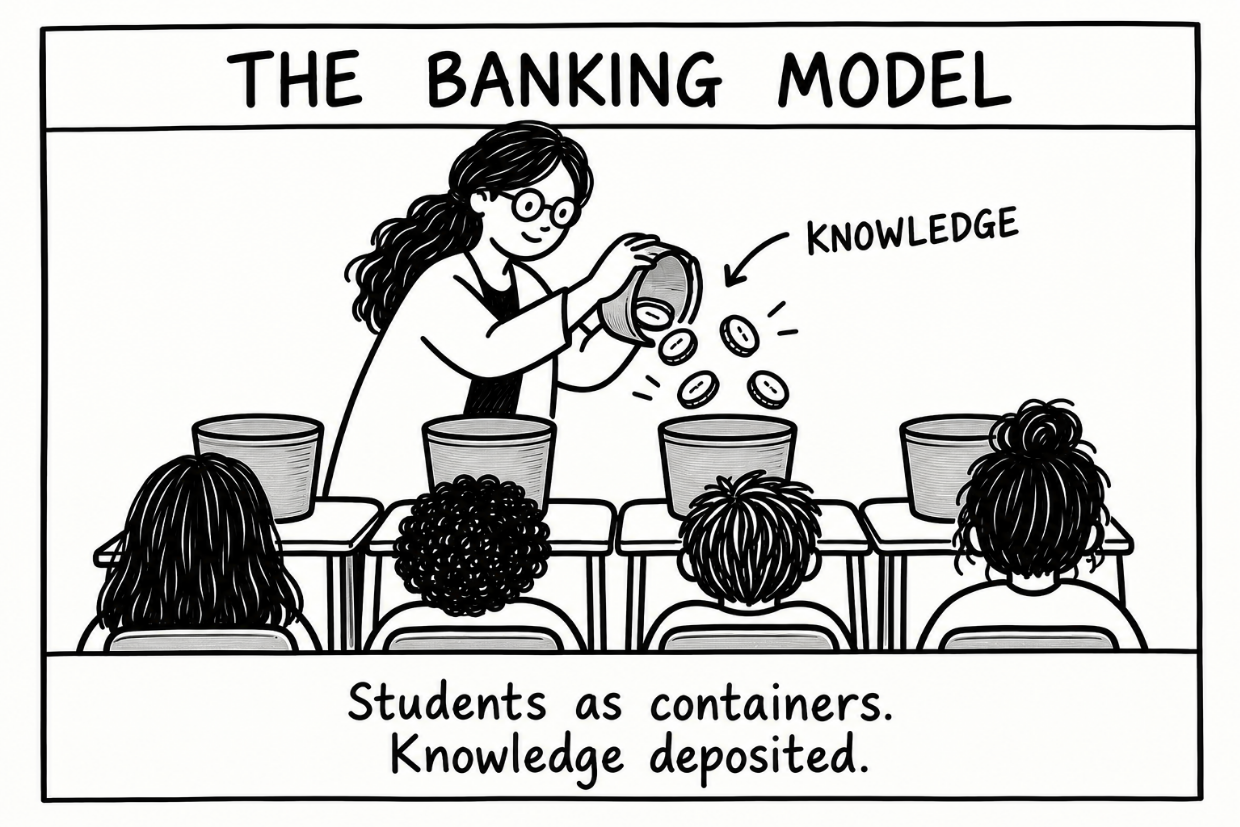
Freire’s banking model challenges an understanding of students as passive recipients of knowledge. Illustration generated with ChatGPT (OpenAI) in collaboration with the author.
I had spent most of my life inside education.
Suddenly, someone had given me language for something I had felt without knowing how to name.
I couldn’t unknow it after that.
Freire’s work is not beyond critique. Even reading him as someone profoundly influenced by his ideas, I can recognize limitations, including language and framing that are strikingly gendered to a contemporary reader. Transformative texts do not need to be perfect texts.
But his distinction between education that reproduces domination and education that participates in liberation fundamentally changed the questions I knew how to ask.
Students weren’t empty vessels. Education didn’t have to be something done to people. Knowledge could be made through dialogue, experience, questioning, relationship, and participation.
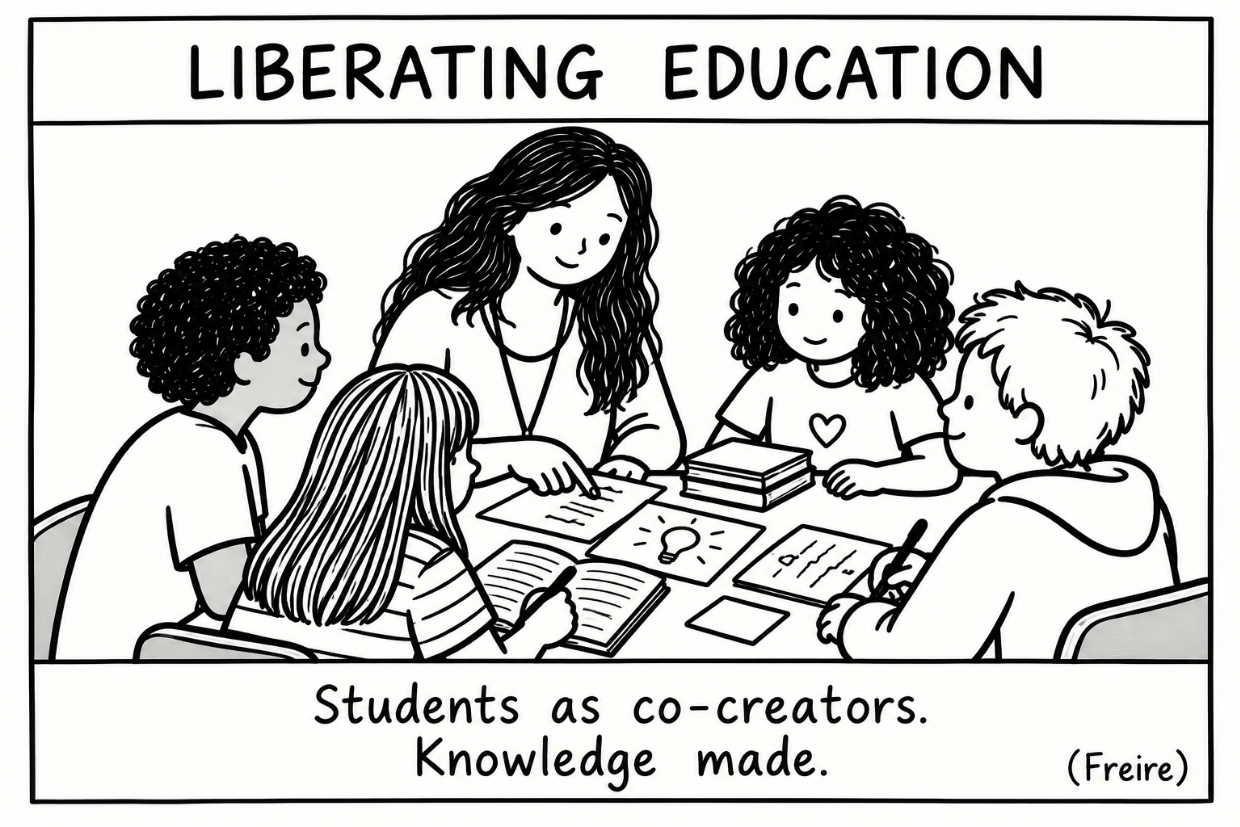
A liberatory alternative positions learners as participants and co-creators in the making of knowledge. Illustration generated with ChatGPT (OpenAI) in collaboration with the author.
The classroom could be a place where people became more human, not more compliant.
The Attentive Learner
And once I understood that, I started seeing the banking model in places far beyond the literal transfer of academic knowledge.
I began noticing how often education assumes there is one correct way to be a learner.
Sit here.
Look here.
Put that away.
Stop moving.
Wait until you’re called on.
Do it this way.
Show me that you understand in the way I have decided understanding should look.
The attentive learner sits appropriately. Their body is quiet. Their regulation is invisible. Their attention is recognizable to the adults around them.
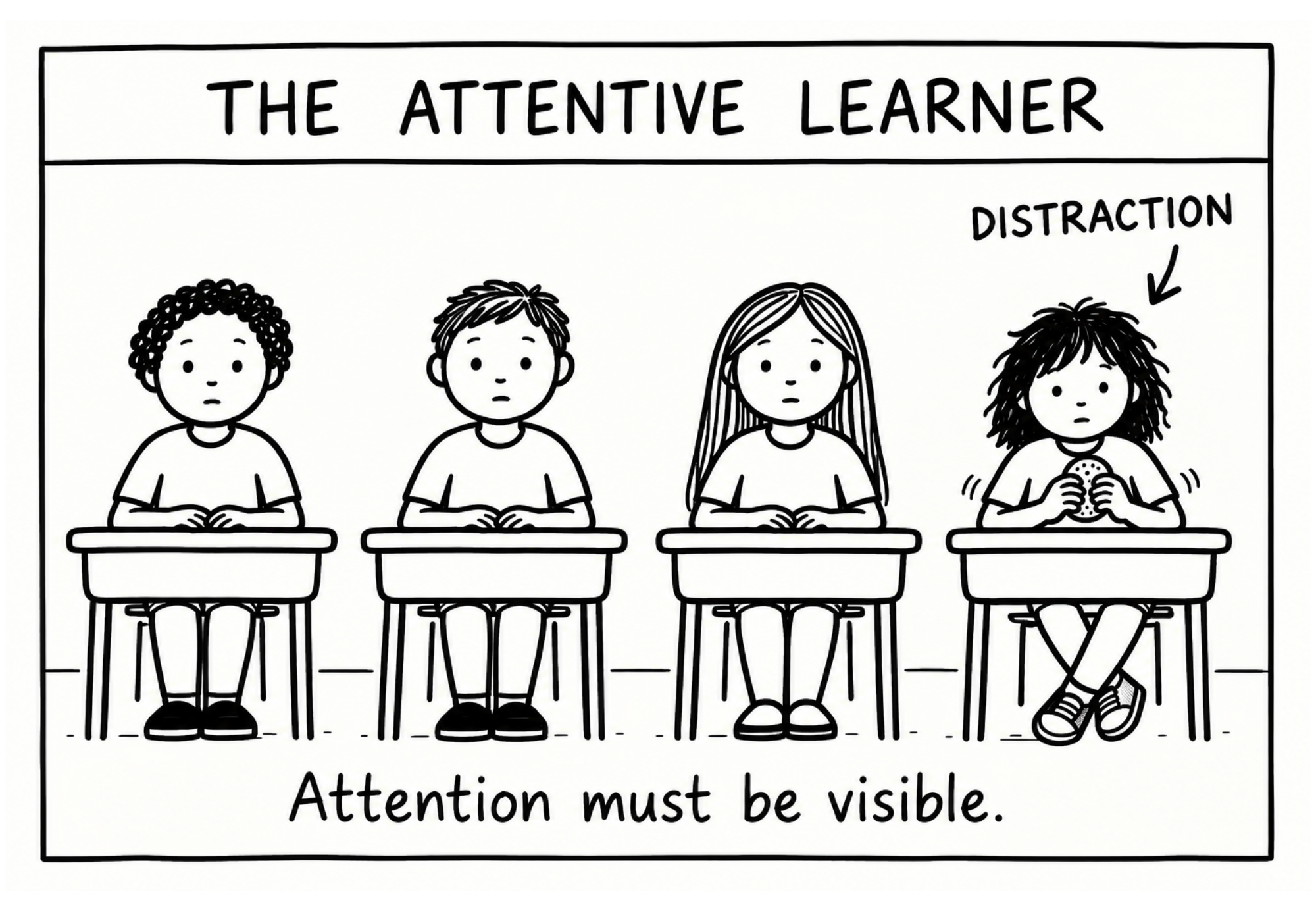
Our expectations of attention often privilege what focus looks like over how a learner actually experiences it. Illustration generated with ChatGPT (OpenAI) in collaboration with the author.
And when a child’s body requires something different, we can interpret that difference first as behavior.
The Things We Call Behavior
That is what caught me in the ParentSquare message.
→A child brings a fidget.
→The fidget becomes a distraction.
→The distraction becomes a behavior problem.
→The behavior problem gets documented.
→Need becomes object becomes disruption becomes behavior.
At no point in that chain do we necessarily have to ask what the child was doing with the object in the first place.
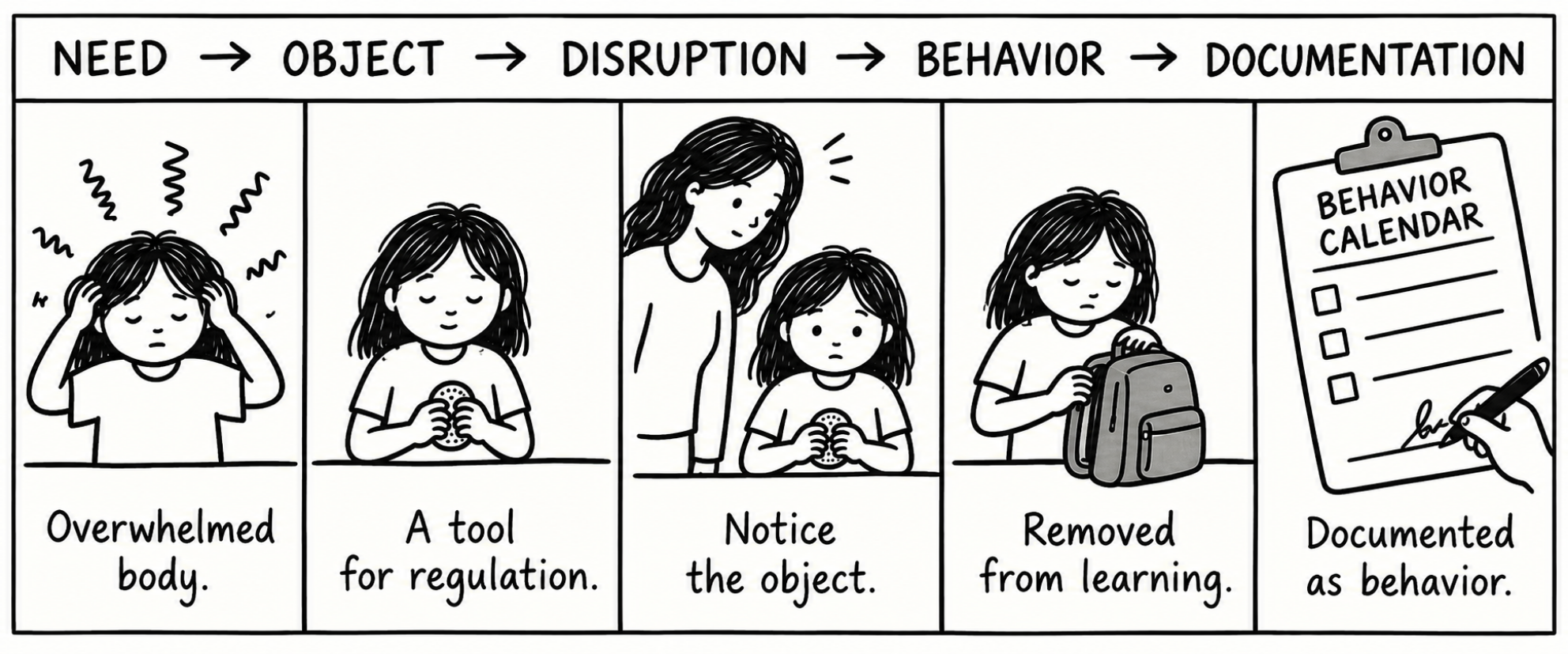
When we begin with the visible object rather than the underlying need, regulation can quickly become reframed as behavior. Illustration generated with ChatGPT (OpenAI) in collaboration with the author.
I don’t think that makes the teachers uncaring. Quite the opposite. I know wonderful, deeply caring educators who make rules like this. I was one of them.
Teachers work inside systems with limited time, limited resources, enormous responsibilities, and classrooms full of children whose needs sometimes genuinely conflict. One child’s clicking fidget may help them regulate while making it nearly impossible for another child to concentrate.
There is no perfectly individualized classroom in which everyone simply gets whatever they want.
But that isn’t what I want.
Something More Relational
What I want is something more relational.
I want us to ask:
What helps you participate here? And how can we make room for that while remaining responsible to everyone else who is participating here too?
That is a very different question from What are the rules?
And maybe that is part of what I’ve been looking for all along.
Because when I look backward now, my professional life doesn’t seem like a collection of unrelated interests in teaching, technology, openness, access, faculty development, learning design, and relational practice.
I see a question getting clearer.
First, maybe it was:
Is there another tool?
Then:
Is there another way to teach this?
Then:
Is there another way for someone to access this?
Then:
Who gets to decide what learning is supposed to look like?
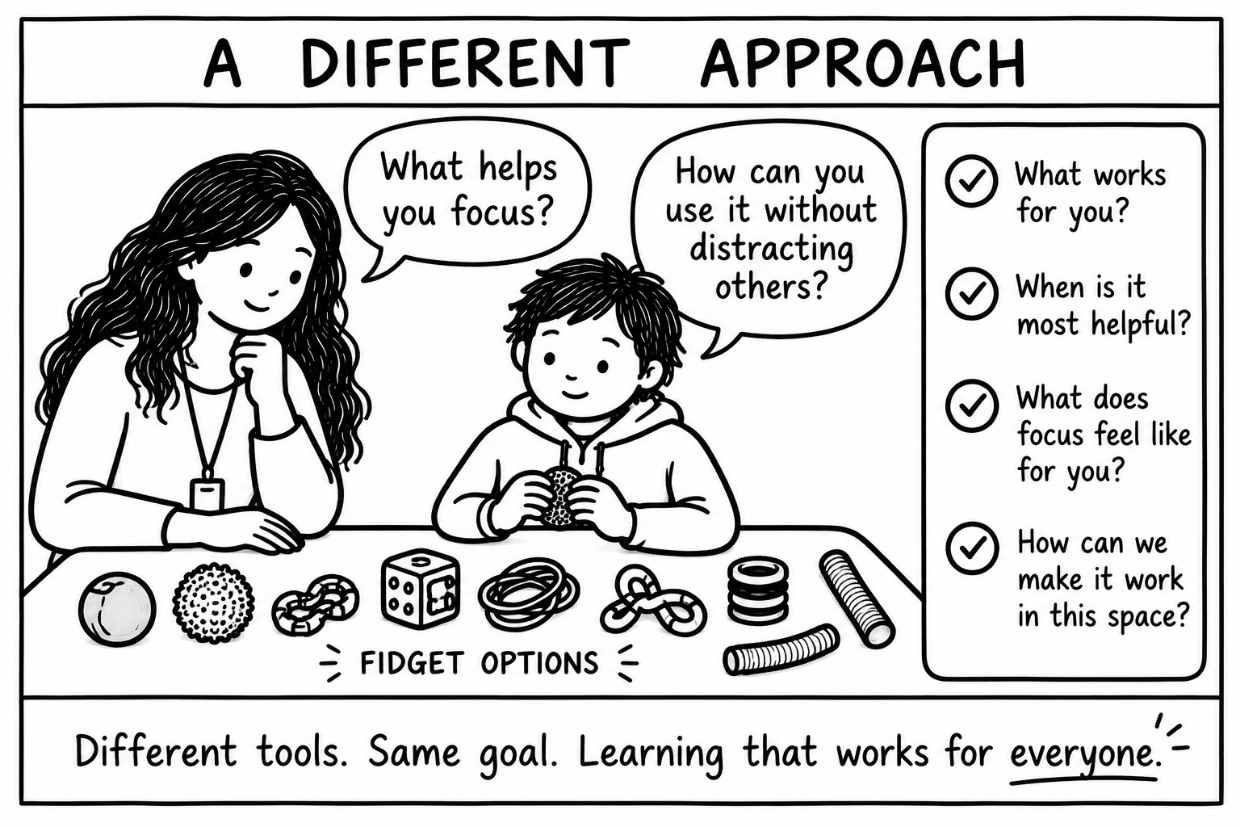
What if self-regulation were treated as a practice children could explore, learn, and negotiate together? Illustration generated with ChatGPT (OpenAI) in collaboration with the author.
And underneath all of those questions, perhaps there was an older one I couldn’t yet articulate.
Does it have to feel this hard to be a person here?
Maybe I Was Following Relief
I don’t want to impose too much coherence on the child I was. She wasn’t secretly developing an educational philosophy. She didn’t understand institutional power or liberatory pedagogy. She certainly wasn’t sitting in elementary school contemplating Freire.
She was uncomfortable.
She was lonely.
She was overwhelmed.
She was trying to figure out why being in the world seemed to require knowing rules everyone else had somehow received.
Maybe she didn’t know there was a better way.
Maybe she simply kept hoping there was.
And perhaps that is why the word I keep returning to now isn’t innovation.
It isn’t technology.
It isn’t even openness.
It’s gentleness.
Gentleness Is Not a Small Educational Idea
Gentleness can sound small beside words like justice, liberation, equity, and transformation.
I don’t think it is.
Gentleness asks whether people really need to hurt this much to participate. It asks whether discomfort is necessary for learning or whether we have confused navigating an institution with intellectual rigor. It asks whether a person should have to suppress their body to demonstrate that their mind is working. It asks whether difference has to become disruptive enough to earn accommodation. It asks whether someone must first prove that something hurts before we are willing to consider whether it needed to hurt at all.
Gentleness doesn’t mean having no expectations of one another.
It might mean having better ones.
Learn what you need.
Learn what other people need.
Learn how your actions affect the people around you.
Practice regulating yourself.
Practice communicating.
Practice changing course when something isn’t working.
Practice making room for another person without disappearing yourself.
Those are extraordinarily high expectations.
There Had to Be More Gentleness in the World
And maybe that’s what I wish I had learned much earlier. Not how to become better at fitting myself into the world exactly as I found it.
How to participate with other people in making the world more livable.
I don’t blame my child’s teachers for the ParentSquare message. I understand it. That’s precisely why it affected me.
I understand the teacher who sent it. I understand the teacher I once was.
And now I understand the child receiving it in a way I couldn’t when I was standing at the front of my own classroom. Maybe becoming an educator has been, for me, a very long process of learning to see all three. And somewhere along the way, I finally found words for something a much younger version of me could only feel:
There had to be a better way.
There had to be more room for us to be human.
There had to be more gentleness in the world.
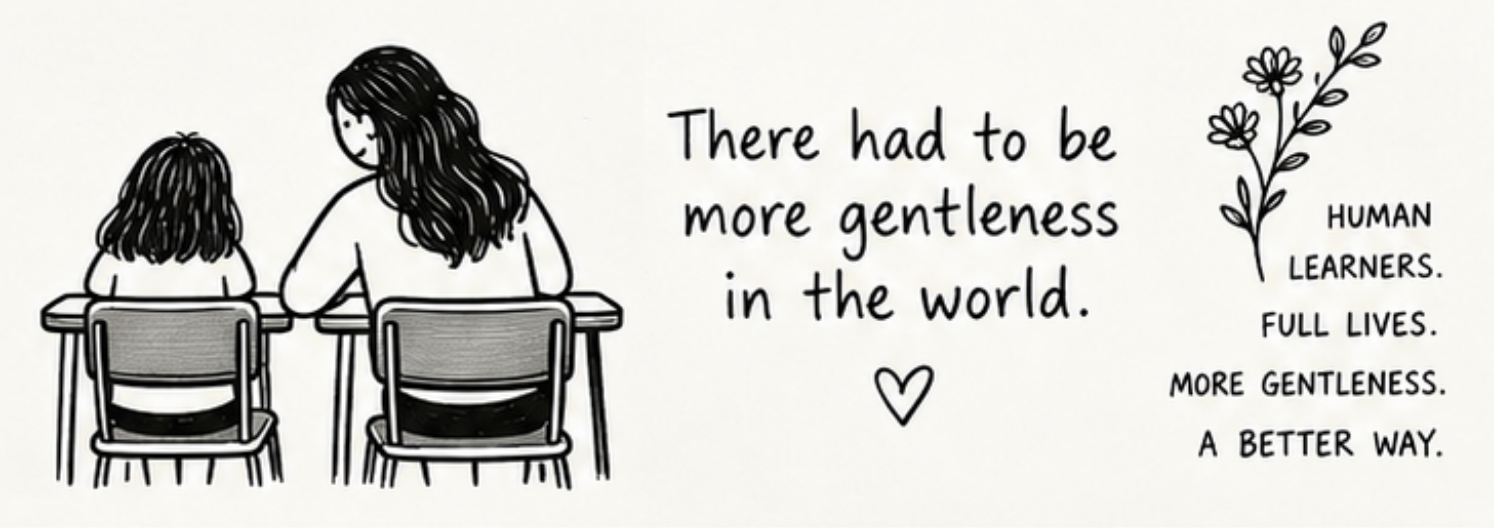
Gentleness asks us not to lower our expectations for learners, but to imagine more human ones. Illustration generated with ChatGPT (OpenAI) in collaboration with the author.
#Education #Neurodiversity #InclusiveEducation #StudentAgency #LiberatoryEducation #PauloFreire #CareInEducation #RelationalEducation #EducationalEquity #TeacherReflection #HumanCenteredLearning #Gentleness